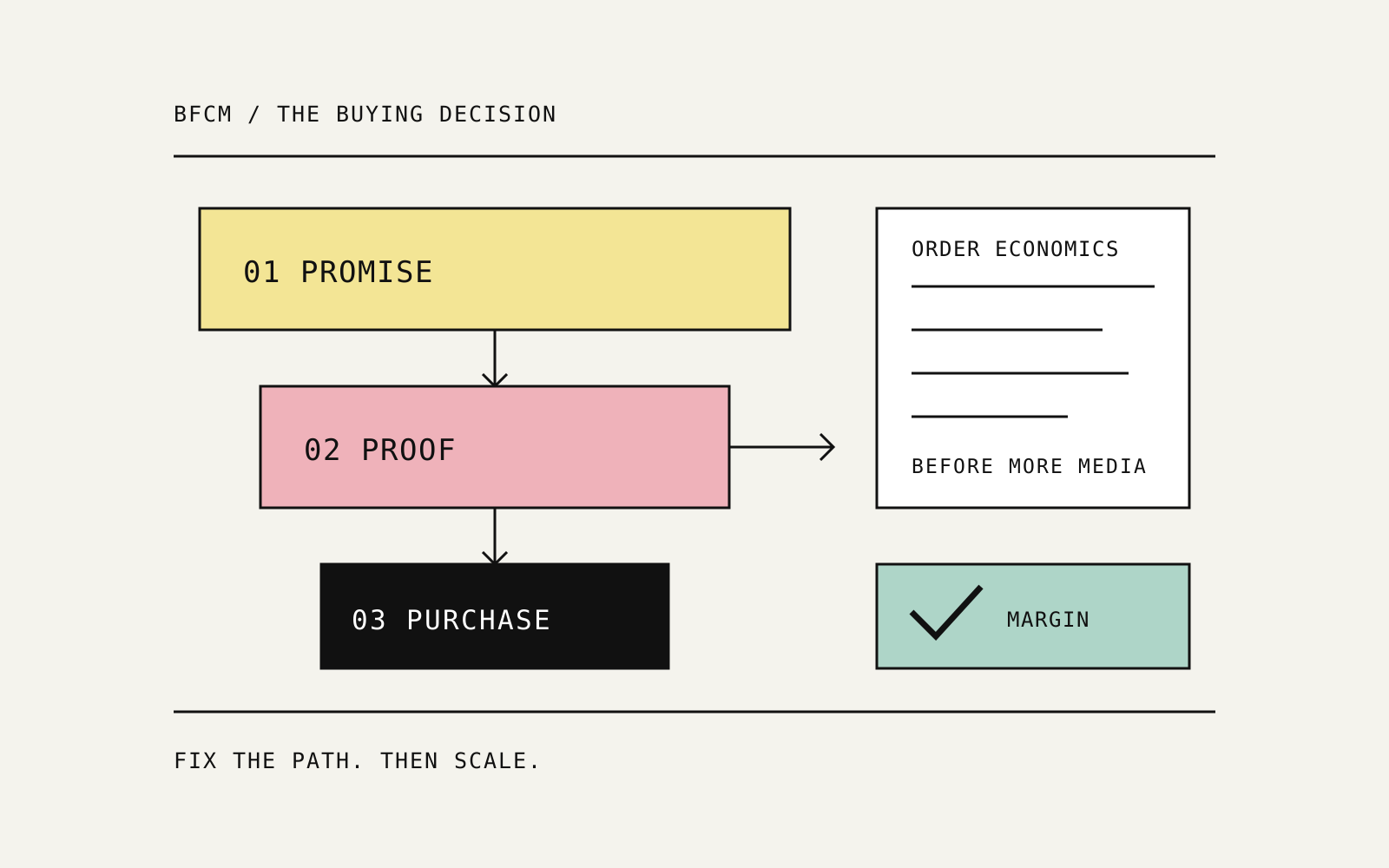
A strong BFCM growth strategy increases the orders worth winning, not just the traffic you can afford to buy. Before Black Friday and Cyber Monday, I want to know where demand is disappearing, what each extra order contributes and which operational mistake could turn a good campaign into expensive noise.
After reviewing the latest Amazon, DTC and AI-commerce developments, my conclusion is straightforward: the advantage is in the sequence of decisions. Repair the commercial constraints first. Then give the best opportunities more exposure.
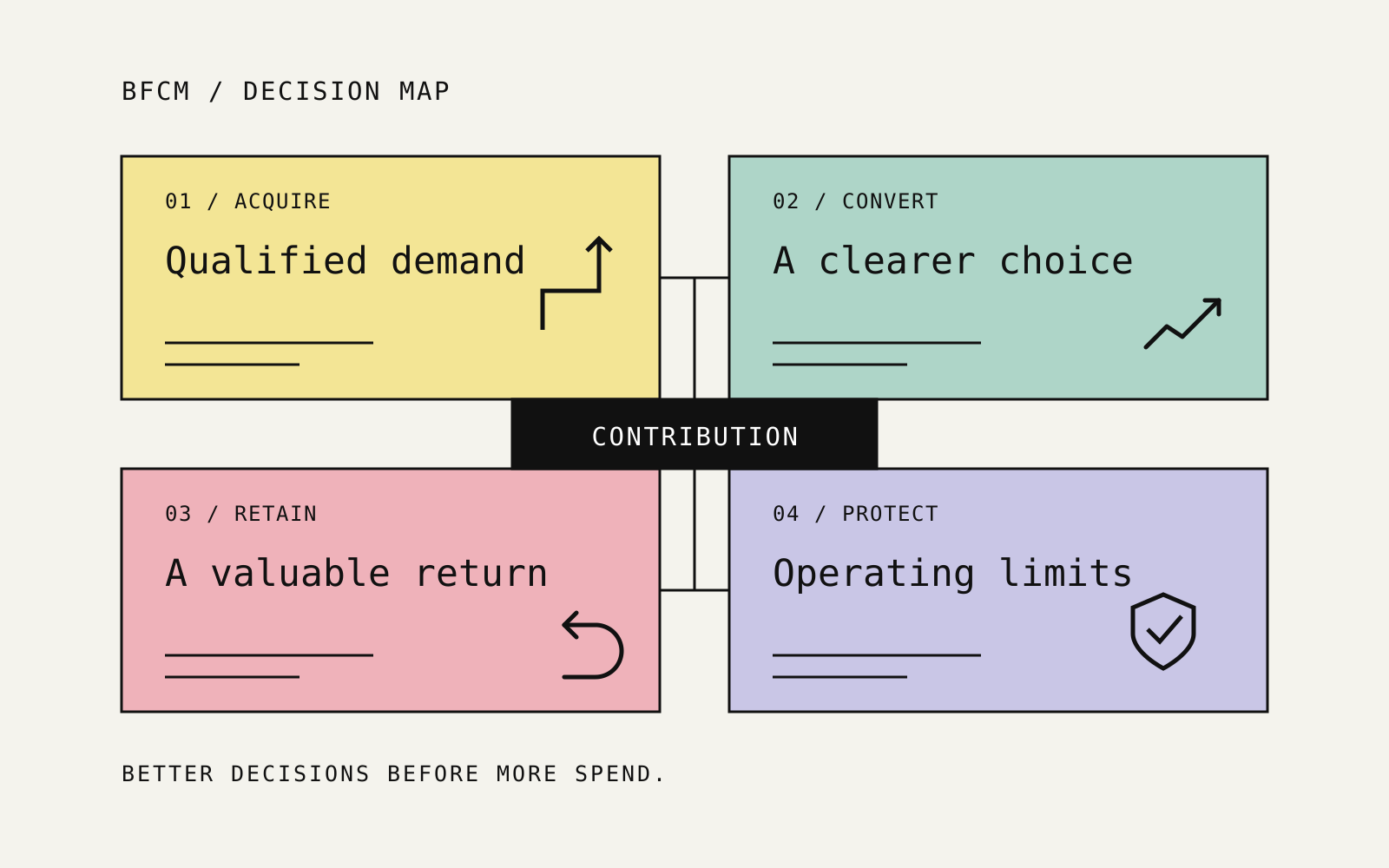
The ten decisions below connect PPC, product economics, mobile conversion, creator output and retention. They are the operating plan I use to turn a collection of marketing ideas into a prioritized growth brief.
1. Decide what advertising automation is allowed to change
Before increasing spend, check who can alter the offer customers actually see. That includes platform automation, not just the people on your team.
OpenAI's creative-enhancement documentation describes automatic changes to ad text, images, language and destination URLs. Enabled variations can run without individual approval. Its current notice schedules automatic enablement for 30 October 2026, preserving existing opt-outs and giving campaign settings priority over the account default.
For a brand using that channel, this is an immediate control review. I check the effective campaign settings, the landing pages available to the system and the claims the business is prepared to stand behind. A promotion that expired on the website should not become source material for a new ad.
My rule is to define the boundary before approving the automation: what may change, who reviews delivery and how an incorrect destination or claim is stopped. New creative volume is useful only when the underlying product information remains accurate.
2. Separate lost Amazon traffic from a conversion problem
A product can convert better and still sell fewer units. If the team reads only conversion rate, it can choose exactly the wrong intervention.
Consider this planning example:
| Period | Sessions | Order conversion | Orders |
|---|---|---|---|
| Before | 10,000 | 4% | 400 |
| After | 6,000 | 6% | 360 |
Conversion improved by 50% in relative terms, but orders fell by 10%. Rewriting the product page is not the first answer to the missing traffic.
The ASIN audit in AM/PM Podcast #566 uses the distinction between traffic and conversion to structure the investigation. My implementation starts with a materially declining product family and comparable reporting windows, then follows the loss through offer availability, sessions, relevant search visibility and advertising coverage.
I want the campaign change log beside the performance chart. Was a productive targeting route paused? Did a product lose availability? Did the mix of traffic change? Classify the problem before commissioning a redesign or increasing bids.
For the offer-health sequence, see my Amazon delivery-promise review.
3. Find repeated PPC waste below the single-keyword threshold
A few clicks on one term can look insignificant. The same mismatch across many queries deserves a closer look.
The PPC Den's n-gram workflow groups recurring words for review before generating proposed bulk changes.
I aggregate clicks, spend, orders and attributed sales, then separate irrelevant intent, expensive converting traffic and efficient patterns. A repeated size mismatch needs a different response from a relevant query still collecting evidence.
Every proposed negative needs its scope and evidence attached. Check the valuable combinations an exclusion could remove, not just the spend it could stop.
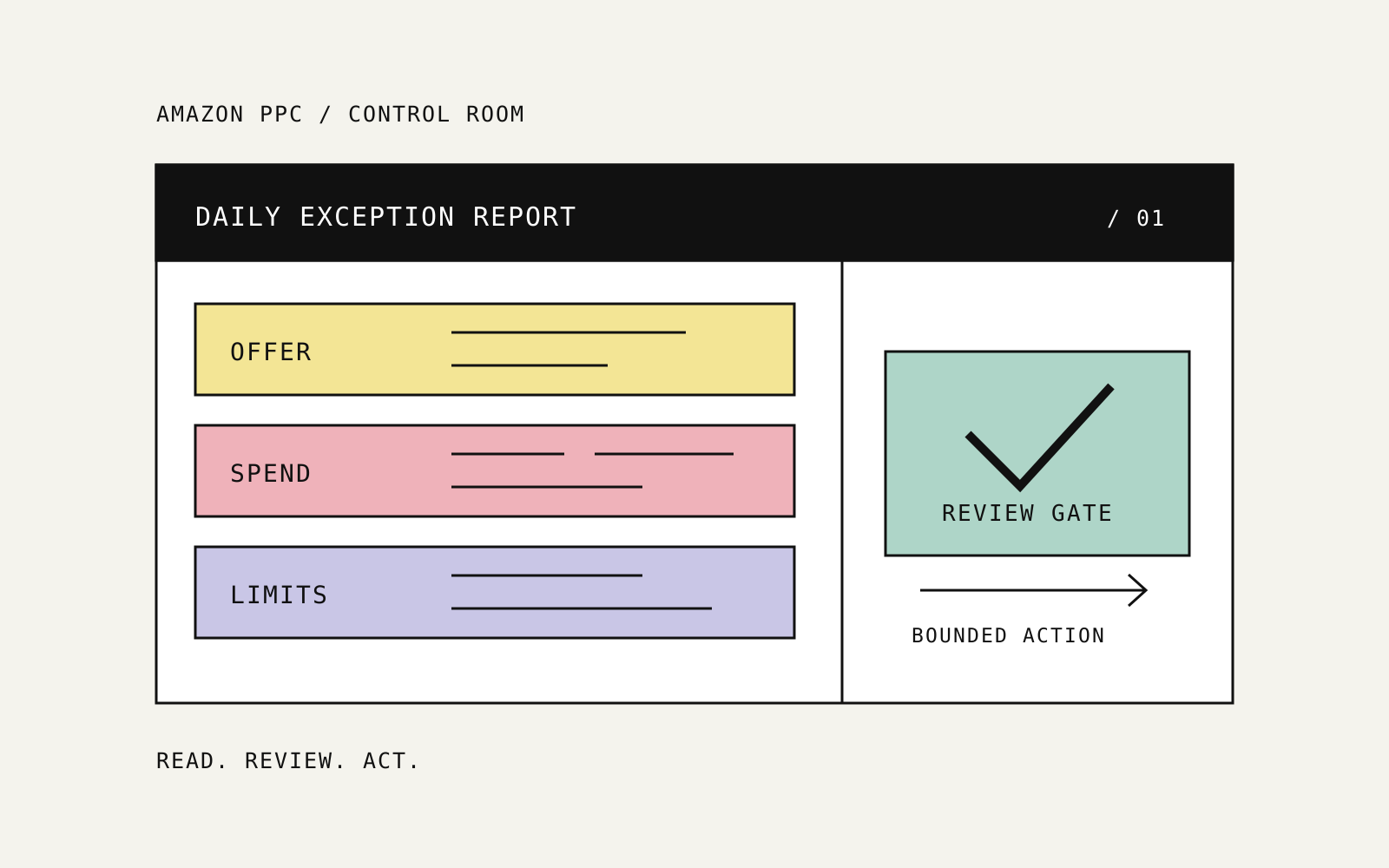
I keep calculations deterministic and use AI to explain the exceptions. The permission model and review gates are covered in my Amazon PPC automation framework.
4. Treat Amazon Business visibility as a margin decision
A badge is a merchandising opportunity, not a reason to discount the entire catalog.
Amazon's current B2B pricing guidance lists Business Savings badge conditions including a minimum 5% discount for single-unit business pricing or 3% on the first quantity tier, together with a product rating of at least four stars. Eligibility and the offer still need checking in the seller's own tools.
I start with products that have a credible business-buyer use case, then compare contribution before and after the proposed price. Quantity, fees and fulfilment can change the economics; none should be assumed from the presence of a badge.
For example, a $50 sale with $15 contribution before a new discount has less room than the revenue number suggests. A $2.50 price reduction leaves $12.50 if other costs stay unchanged: a 16.7% reduction in contribution per unit. Holding total contribution steady would require 20% more units at that new contribution level.
That calculation turns a vague visibility idea into a testable commercial question: can this offer produce enough additional profitable demand?
5. Audit packaging at the fee boundary, not in isolation
Some of the best growth work sits outside the ad account. A small packaging change can matter when it crosses a verified fulfillment-fee threshold.
The packaging example discussed in Weekly Buzz #565 is useful for the mechanism: a dimensional change can move a product into a different size tier. I use that as a prompt to measure the actual production-packed product, not as a savings rate to copy.
My review starts with high-volume items near a confirmed boundary. Compare the current packed dimensions and weight with the applicable fee estimate, then include packaging materials, inbound transport, storage, damage and returns in the model.
A cheaper shipment that arrives damaged is not an operating improvement. Test the delivered condition, verify the fee treatment and calculate the net per-unit benefit before ordering a full packaging run.
The decision belongs with operations and marketing together. A compression change can affect product presentation just as easily as it affects shipping cost.
6. Build a creator pipeline, not a posting quota
The useful insight from O Positiv's DTC interview is that creator content can generate several outputs: audience reach, product sales and interest from additional affiliates. Those outputs need different measurements.
For a BFCM plan, I work backwards from when approved content must be usable. Sampling, delivery, creation, revisions and usage permissions all consume time before a post can contribute anything.
My pipeline records creators contacted, samples received, content approved, organic orders, inbound affiliate interest and assets eligible for paid use. That shows whether the bottleneck is recruitment, production or amplification.
Then I evaluate the economics. Include sampling, commissions, usage fees and paid distribution alongside net revenue and returns. A video can be a strong recruitment asset without being the best direct-response ad. A paid campaign can look efficient while relying on a commission structure that makes the final order unattractive.
Scale the creator relationships and content types that perform a defined job. Another brand's weekly posting volume is not a production brief.
7. Remove one observed mobile purchase obstacle
Mobile conversion improvements should start with the customer path, not a list of widgets to install.
Pilothouse's mobile purchase-bar proposal addresses a specific obstacle: readers can move far below the original buy section and lose easy access to the purchase action. Its proposed bar preserves the chosen variant, price and button after the original section leaves view.
The separate Hungry Minds review raises other candidates: clearer editions, proof nearer the purchase decision and deferred heavy media. I treat these as alternative test directions, not a package of simultaneous changes.
Inspect one important mobile landing journey and choose the obstacle you can actually observe. Check whether the selected variant survives, whether the bar covers content and whether checkout remains reachable inside the traffic-source app.
The winner needs better completed purchases or contribution, not merely more add-to-cart taps. My BFCM conversion plan covers the wider message-to-checkout sequence.
8. Separate Meta prospecting from paid repeat business
An acquisition campaign can report excellent returns while spending heavily on people who already know the brand. That is a classification problem before it becomes a budget decision.
In Pilothouse's apparel-brand example, spend reaching existing customers fell from more than 30% to below 5%, while US and Canadian sales increased 28% year over year over the reported comparison period. Creative, promotions and product drops were part of the program too.
My takeaway is to inspect the audience mix, not adopt a universal existing-customer percentage. Retention can deserve paid budget; it should have an explicit objective rather than be counted as new-customer acquisition.
Review customer-list freshness, permitted data use, audience definitions and the actual new-versus-existing breakdown. Then compare acquisition cost, contribution and customer quality for a bounded change. A cleaner prospecting report is useful, but the business still needs more valuable new customers, not just a tidier dashboard.
9. Test purchase-history cohorts before expanding email reach
Purchase history deserves its own BFCM test, rather than being buried inside an engagement segment.
The TWBERP cohort discussion highlights older buyers as a useful test audience. I turn that into a controlled comparison, not a universal purchase-age cutoff.
Use consented, non-suppressed purchase-age cohorts, a comparable opener-led group and a holdout. Keep timing and the offer consistent.
Compare incremental repeat orders and contribution with unsubscribes, complaints and deliverability. Expand only when commercial returns and list health support it.
10. Judge AI shopping by correct purchases, not conversation length
A shopper who finds the right product in fewer steps may be having a better experience, even if page views and session time fall.
Practical Ecommerce's AI-shopping measurement analysis makes that distinction explicit. The question is whether the shopper reaches a correct, useful outcome, not whether the assistant produces more messages.
The Vercel Shop implementation illustrates the technical direction: an existing commerce backend can support both a human interface and structured access for agents. That does not make a framework migration the first commercial priority.
I start with product facts: exact dimensions, material, included pieces, variant identity, current price and availability. Then define representative customer tasks and check whether the assisted journey selects the right variant and reaches a valid checkout.
Measure task completion, purchases, contribution and subsequent return reasons. A fast recommendation for the wrong size has simply moved the cost from discovery to customer service.
My BFCM execution order
Ten ideas should not become ten competing projects. I rank them by the value at risk, the evidence available and the time needed to make a controlled change.
| Workstream | First useful output | Decision owner |
|---|---|---|
| Controls and offer health | Effective automation settings, accurate offer, available product | Channel lead and operations |
| Traffic and PPC | One supported cause of decline and a reviewed action queue | Acquisition lead |
| Unit economics | Contribution model for the proposed discount or packaging change | Finance and operations |
| Mobile conversion | One observed obstacle, one controlled test | Ecommerce lead |
| Creators and retention | Costed production pipeline and measurable customer cohorts | Growth lead |
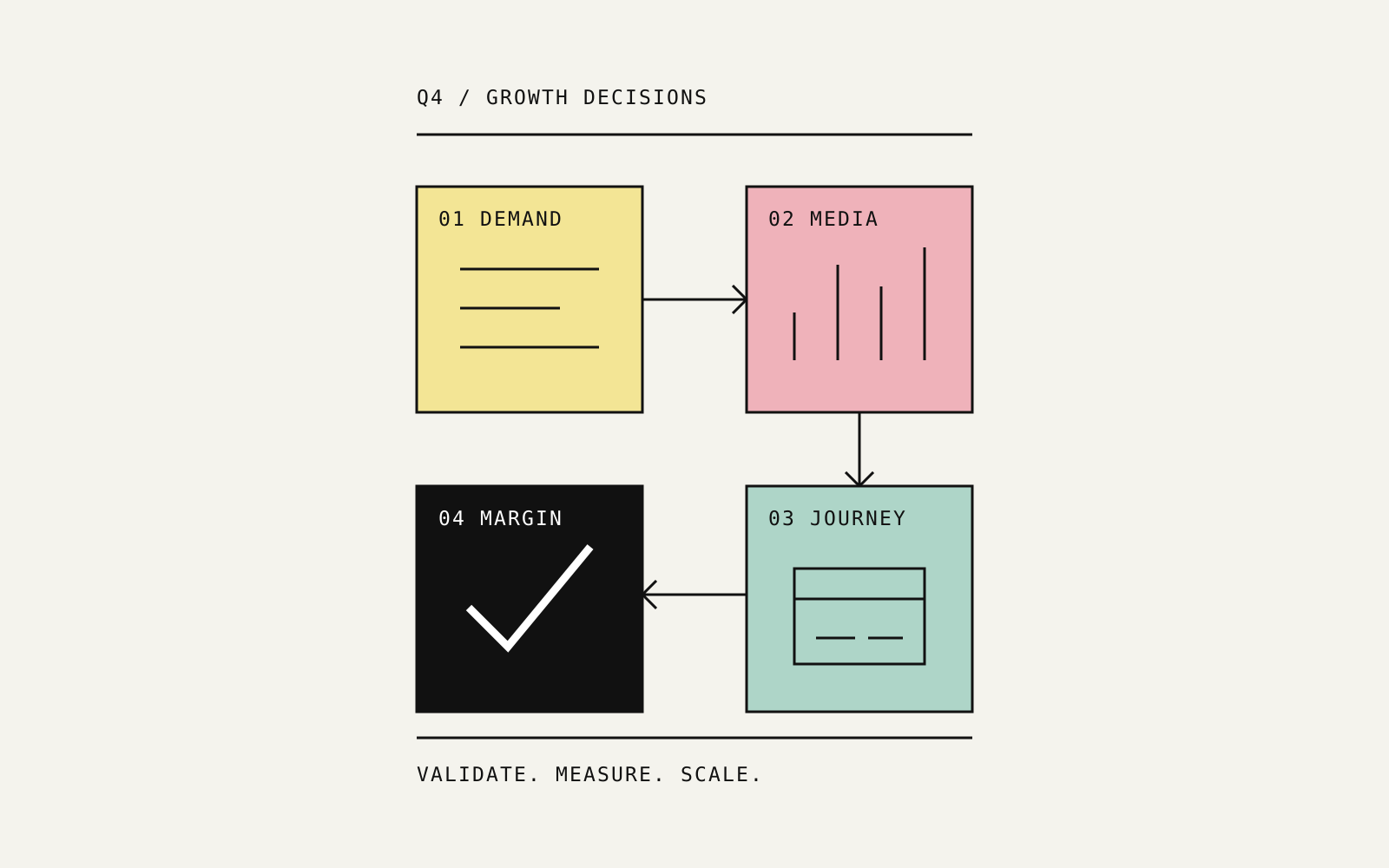
First, stop anything materially wrong: an unavailable offer, an incorrect claim or a broken purchase route. Next, repair a documented loss of qualified demand. Then test an improvement with a clear owner and measurement plan.
For every change, I record the hypothesis, affected products or audiences, baseline, budget or exposure limit, review date and stop condition. Keep unrelated changes separate so the team can understand what happened.
The best BFCM plan is not the longest campaign calendar. It is the shortest credible route from today's constraint to more profitable customer demand.
If your team needs that prioritization, explore my Amazon advertising consulting, conversion optimization and marketing analytics, or discuss your growth challenge.
BFCM growth strategy FAQ
What should an ecommerce team fix before increasing Black Friday spend?
Check offer availability, product information, the mobile purchase route and contribution first. Then diagnose whether the main constraint is missing qualified traffic, weak conversion or unattractive order economics. Choose the intervention that addresses that constraint.
Can Amazon sales decline while conversion improves?
Yes. Orders depend on both traffic and conversion. In the worked example above, sessions fall from 10,000 to 6,000 while conversion rises from 4% to 6%; orders still decline from 400 to 360. Review those components together.
Is n-gram analysis a reason to automate negative keywords immediately?
No. It is a way to identify recurring search-intent patterns. Review relevance, attribution maturity, product context and the proposed exclusion scope before approving changes. Keep evidence and approval attached to the action file.
Which metric should connect BFCM acquisition and retention?
Use contribution with consistent cost definitions, supported by the metrics appropriate to each job. Acquisition needs a view of valuable new customers; retention needs incremental repeat business. Do not combine channel-attributed revenues as if each channel created a separate order.
Source notes
- Advertising controls: OpenAI, Creative enhancements for ChatGPT Ads, including effective settings and the rollout notice checked on 29 October 2026.
- Amazon diagnosis and PPC: AM/PM Podcast #566 and The PPC Den, wasted-spend and n-gram workflows.
- Business pricing and packaging: Amazon's B2B pricing guidance and the packaging discussion in Weekly Buzz #565.
- Creator operations: DTC, O Positiv affiliate discussion, 21 October 2026.
- Conversion and retention: DTC, mobile purchase-bar and purchase-history tests, 22 October 2026, and the Hungry Minds review, 23 October 2026.
- Prospecting: DTC / Pilothouse, apparel-brand audience mix, 20 October 2026.
- AI shopping: Practical Ecommerce, AI Shopping Metrics Considered, 22 October 2026 and Vercel Shop's first-party implementation overview.
- Calculations and execution framework: the sessions/order comparison and discount model are worked examples; the prioritisation, review sequence and implementation brief are my analysis.