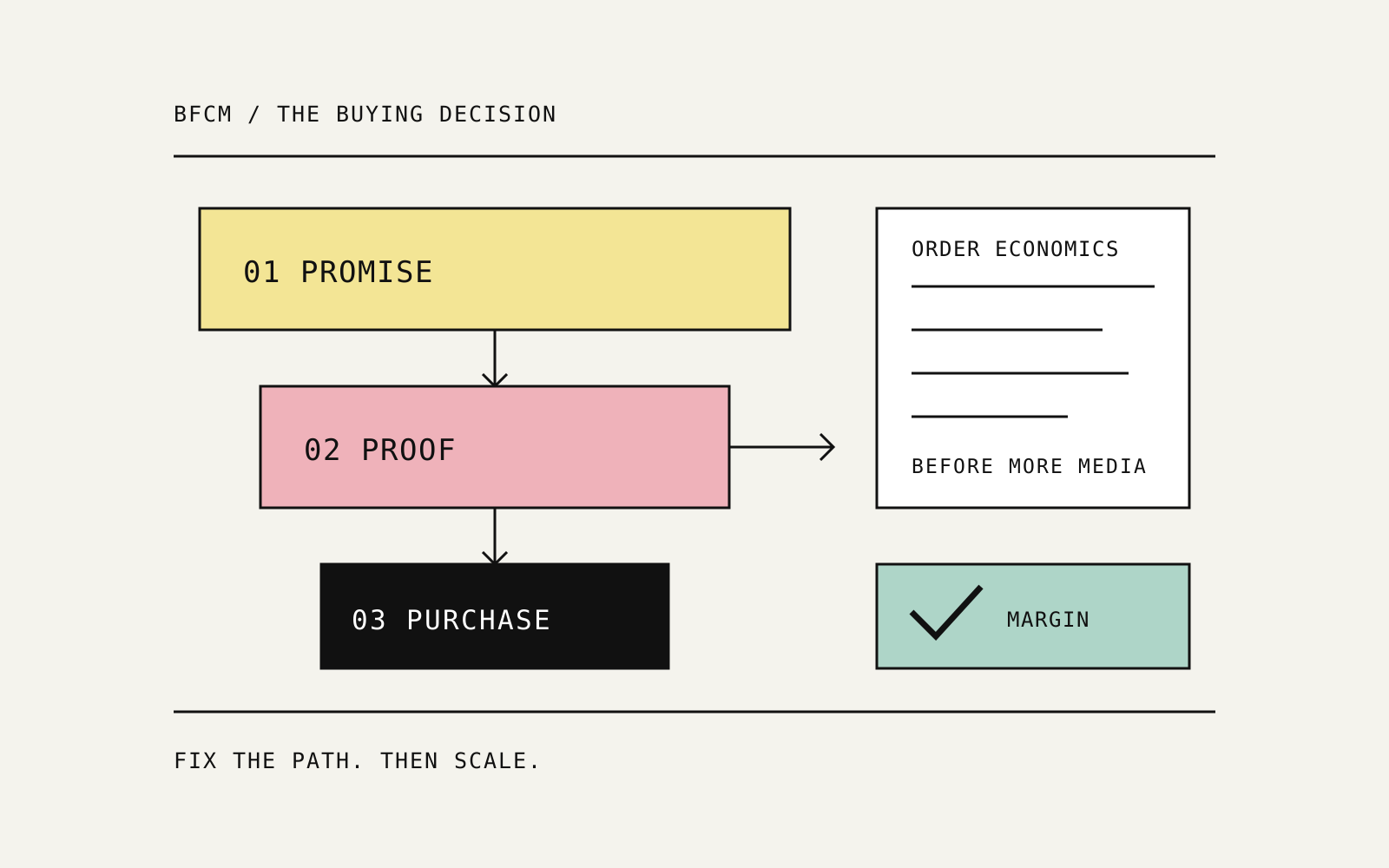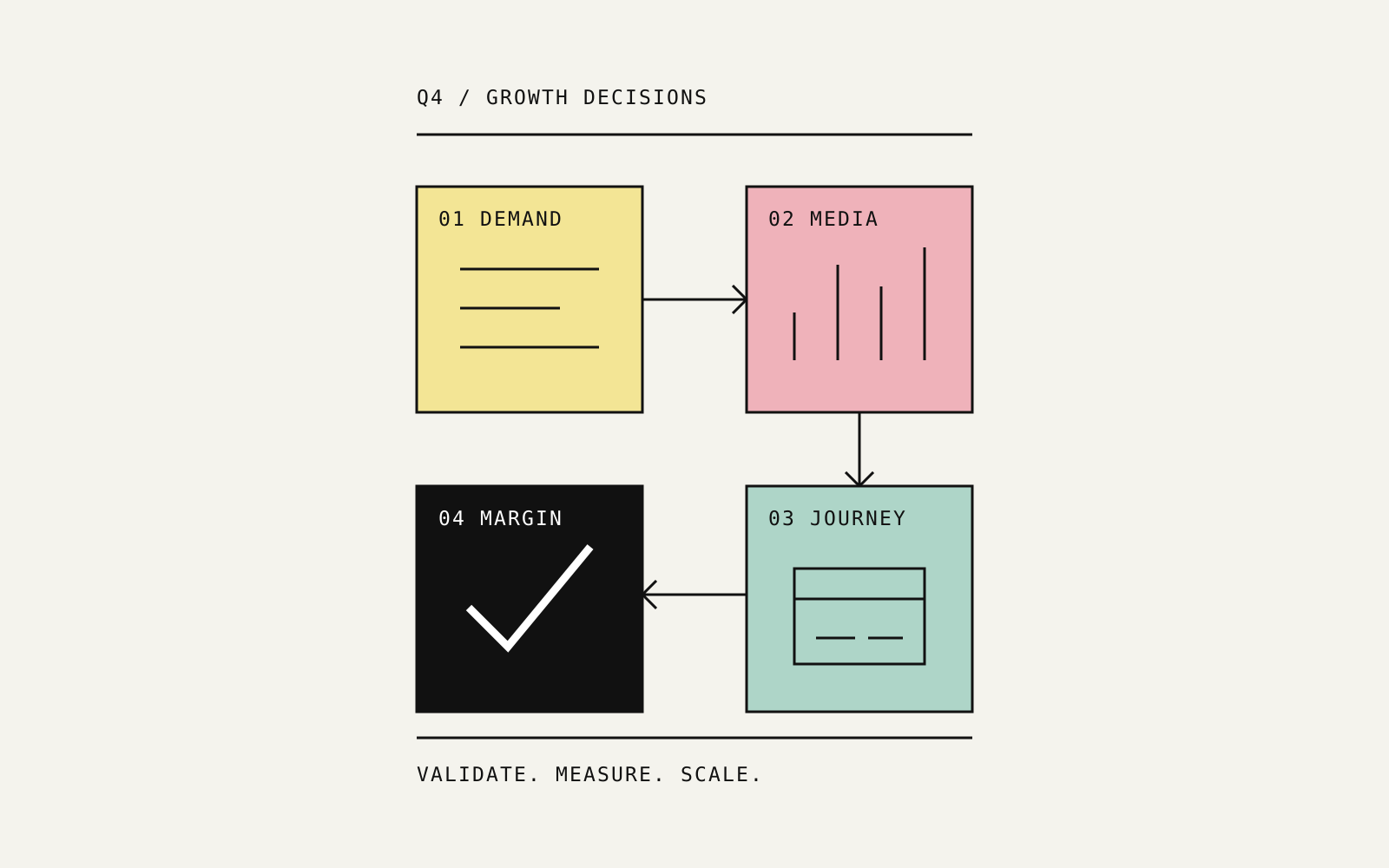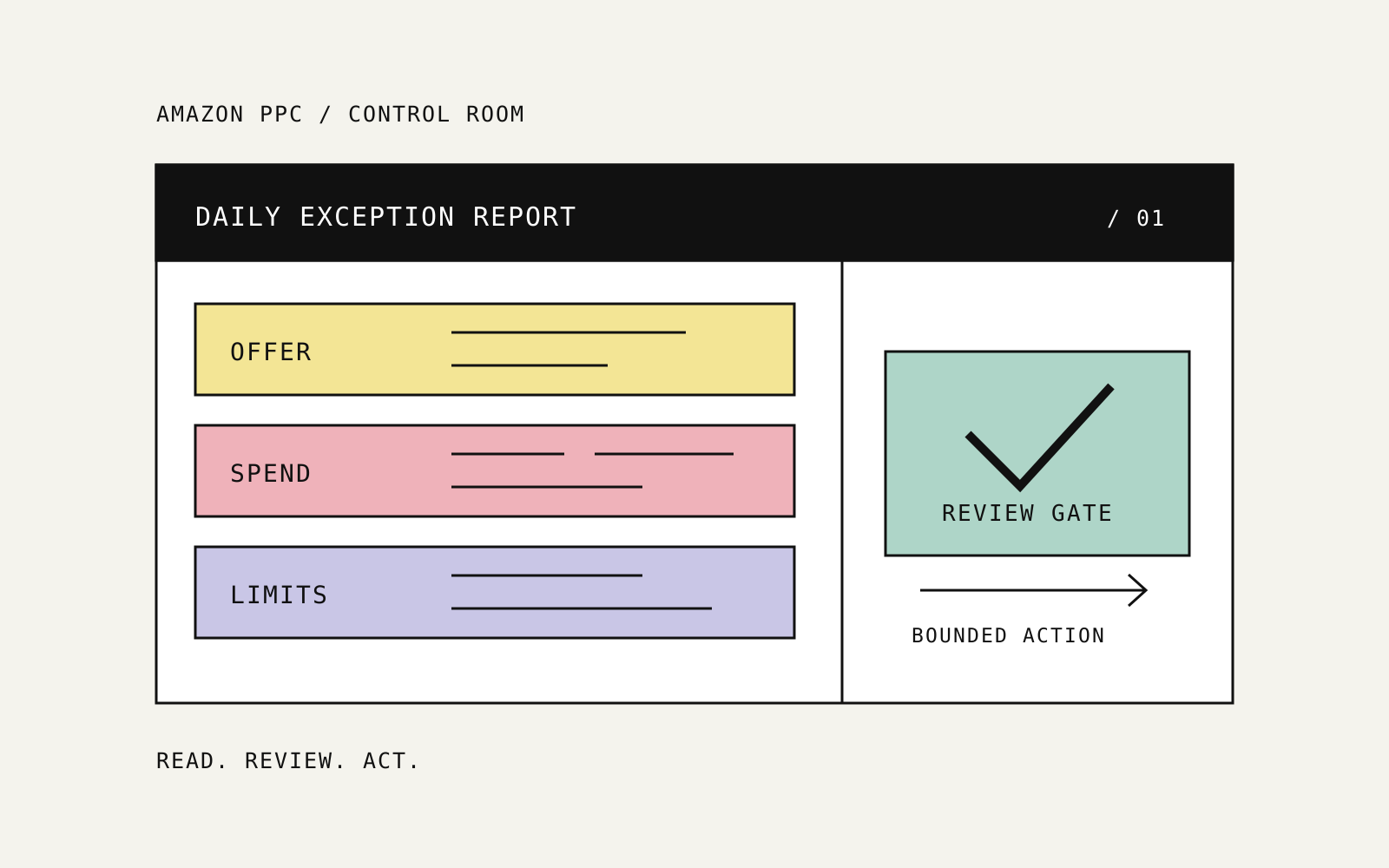
Amazon PPC automation should find the decisions that need attention before it starts changing bids. My preferred starting point is a daily exception report that connects advertising spend with offer health, inventory and product economics.
A bid robot can execute a bad rule all night. That is not a competitive advantage.
My starting point is a clear division of work: code calculates, AI explains, and the operator decides what deserves a change. A new AI interface matters less than the quality of the decisions behind it.
Here is the system I would build before giving an agent permission to spend a brand's money.
Start with the morning decision, not the AI prompt
In its 16 October PPC Den episode, Ad Badger demonstrated a scheduled morning report covering non-converting search terms, inefficient ASINs and Buy Box suppression. One account example showed $6,700 spent over 30 days on terms with no attributed orders.
That is a useful investigation queue. The commercial value comes from finding the cause and deciding what to do next.
My reporting brief starts with an output: show the five exceptions most likely to change today's priorities, with enough evidence to review each one.
Every item needs the affected product or campaign, the reporting window, the raw numbers, the suspected cause, the next check and a named owner. A paragraph saying performance looks unusual is not a decision tool.
| Exception | Evidence I want attached | First decision |
|---|---|---|
| Search-term spend without orders | Spend, clicks, query, match type, product and attribution maturity | Investigate traffic quality or continue collecting data |
| Sudden impression decline | Campaign state, offer eligibility, stock and delivery promise | Repair the selling surface or investigate the auction |
| Contribution deterioration | Net sales, advertising cost, discounts, fees and return allowance | Fix the cost driver or reduce exposure |
| Stock coverage falling | Sellable units, daily demand and replenishment timing | Protect availability before expanding demand |
| Conflicting bid changes | Current settings, recent change log and automation owners | Establish one controlled change process |
The point is not to produce more alerts. It is to shorten the distance between a material problem and a defensible decision.
Check whether the product can sell before changing the bid
When impressions or conversion fall, teams often reach for the advertising controls first. I reverse that sequence.
Is the exact advertised variation available? Is the offer eligible? Is the delivery promise competitive in the locations that matter? Has the price, promotion or product page changed?
An account-level health indicator cannot answer every product-level question. A campaign can look active while the commercial offer behind it has deteriorated.
My diagnostic order is offer, availability, conversion, then auction settings. If the product is unavailable, a larger bid does not repair it. If the delivery promise has slipped, a cheaper click does not automatically restore purchase intent.
This is why I connect the ad report to the catalog rather than reviewing them as separate businesses. My delivery-promise audit and inventory-aware PPC framework cover those checks in more detail.
Zero-order spend is a review queue, not an automatic negative list
Two search terms can have the same number of orders and require opposite decisions.
Consider this worked example. Both rows have zero attributed orders in the selected window; neither is an account result.
| Search-term situation | Clicks | Spend | My next step |
|---|---|---|---|
| Relevant term with limited recent traffic | 8 | $12 | Check the attribution window and keep the learning budget bounded |
| Clearly irrelevant query for the advertised product | 90 | $135 | Confirm the query and targeting path, then review an exclusion |
The first row has very little evidence. The second has a relevance problem that more patience will not solve.
For relevant terms, I compare clicks and spend with the product's expected conversion behavior and allowable acquisition cost. I also check whether the reporting window is mature enough to judge. A purchase that has not yet appeared in the selected report is not the same thing as a purchase that never happened.
The rule should reflect the product's role. A launch test, a defensive branded campaign and an established generic keyword do not share one universal stop threshold.
Automate the flag. Review the reason. Then decide whether to exclude, reduce, repair or keep testing.
Keep the arithmetic outside the language model
I want AI to explain a calculation, not improvise it.
The reporting layer should aggregate spend, sales, orders and costs in code or SQL. Calculate ratios from their components. For example, portfolio ACoS is total advertising spend divided by total attributed advertising sales, not an unweighted average of campaign percentages.
Here is why the distinction matters:
| Campaign | Ad spend | Attributed sales | ACoS |
|---|---|---|---|
| A | $100 | $1,000 | 10% |
| B | $100 | $200 | 50% |
| Combined | $200 | $1,200 | 16.7% |
The simple average of the two campaign ratios is 30%. The combined ratio is approximately 16.7%. Same inputs, very different management story if the aggregation is wrong.
My data contract records the account, currency, timezone, reporting dates, attribution basis and extraction time. Advertising sales and financial net revenue stay separately named. A later return can change contribution without making the original click report incorrect.
Then the AI layer receives the checked table and a bounded job: explain the exceptions, identify missing evidence and draft the next review steps.
Set economic limits before allowing automated changes
A universal ACoS or TACoS target is not a substitute for a cost model. In AM/PM Podcast #564, the discussion connects campaign experimentation, audience targeting and AI-assisted reporting with the need for clear business priorities. That is the useful lesson to carry into an automation brief.
For an illustrative order with $50 in net sales and $18 in contribution before advertising, reserving $6 in contribution after advertising leaves $12 for acquisition. At a 10% click-to-order conversion rate, that implies an average click-cost allowance of $1.20 under those assumptions.
Change the conversion rate, return cost or discount and the allowance changes. It is a planning calculation, not a universal bid recommendation or a guarantee about an individual auction.
The operating question is whether current auction exposure can fit the product's economics. Base bids are only one input. Inventory every setting that can affect exposure, including placements, audience adjustments, dynamic bidding and external automation. Verify how the specific ad product combines them rather than inventing one stacking formula for the whole account.
My ACoS and TACoS article explains the ratio definitions. The automation layer adds a second requirement: the limit must be explicit enough for software to enforce and for a human to audit.
Separate reading, recommending and writing
Connecting an AI tool to an advertising account is not one permission decision. It is at least three.
| Stage | What the system can do | Evidence required before expansion |
|---|---|---|
| Read | Retrieve reports and detect exceptions | Correct calculations and traceable source rows |
| Recommend | Propose a bounded change and explain it | Useful recommendations after operator review |
| Write | Apply an approved change within limits | Permission boundaries, change log, rollback and reliable monitoring |
I start read-only. A scheduled report should prove it can distinguish a selling problem from a targeting problem before it receives write access.
Before enabling writes, define the allowed products and campaigns, maximum change size, daily spend boundary, inventory stop, cooldown and approval owner. Record the previous value so a reversal is possible. Give each operation an identifier so a retry does not apply the same change twice.
Also establish who else can change the account. If an agency, an Amazon rule and a separate agent all adjust the same campaign without coordination, the next report may be diagnosing the automation rather than the market.
Measure whether the automation is worth maintaining
A successful scheduled run is an engineering event. A useful commercial outcome is something else.
I score a reporting workflow on calculation accuracy, actionable exceptions, false alarms, review time and maintenance effort. For write-enabled workflows, I add actual changes, reversals, spend boundaries and the measured effect on contribution.
My operating calculation is straightforward: net time saved equals manual work avoided minus review, maintenance and recovery time. If a workflow avoids three hours of reporting but consumes four hours of checking and repair, it has moved the work rather than removed it.
Build failure behavior into the brief. Stale or incomplete data should produce a visible warning and no recommendation to increase spend. A missing report should never be interpreted as zero sales. A failed write should leave an auditable result, not a silent assumption that the change happened.
This is the difference between a useful operating system and a demo that looks good on the day it is presented.
My rollout plan for an Amazon PPC reporting agent
I would implement the first version in five steps:
- Define the decisions. Select the small set of exceptions the account owner actually needs to review.
- Build the checked data layer. Reconcile native exports, reporting windows, product mappings and contribution inputs.
- Run in shadow mode. Compare the report with the operator's review without allowing account changes.
- Review recommendation quality. Log correct findings, false positives, missed issues and time spent resolving them.
- Expand one permission at a time. Allow only a narrow, reversible change class after its reporting and controls work reliably.
Success is a shorter, better decision process with visible commercial limits. It is not the number of actions an agent can execute.
If you need that structure, explore my Amazon advertising consulting and marketing and sales analytics, or discuss your reporting bottleneck.
Amazon PPC automation FAQ
What should I automate first in Amazon PPC?
Start with report preparation, product-health checks and exception detection. Keep the first version read-only so the team can verify the numbers and recommendations before giving it permission to change budgets or bids.
Should an AI agent automatically pause every search term with zero orders?
No. Review relevance, spend, clicks, attribution maturity, offer health and the product's objective. Zero-order spend identifies something to investigate; it does not supply the full decision.
Can a lower TACoS hide a weaker Amazon business?
Yes. Reducing advertising can lower TACoS while total sales and contribution deteriorate. Review the ratio alongside sales, margin, inventory and other acquisition costs over comparable periods.
How do I judge whether PPC automation is working?
Measure accurate reporting, useful exceptions, fewer false alarms, net review time saved and controlled execution. Evaluate spending changes through contribution and a clear comparison, not through activity counts alone.
Source notes
- Daily exception reporting: The PPC Den, 16 October 2026, including the morning report, the $6,700 zero-order-spend example and the separation of calculations from AI commentary.
- Campaign testing and reporting: AM/PM Podcast #564, with Carrie Miller, Destaney Wishon and Jason Ross.
- Worked calculations: the search-term rows, campaign aggregation and $50 order model are illustrative calculations developed for this article. The rollout plan and review structure are my synthesis.