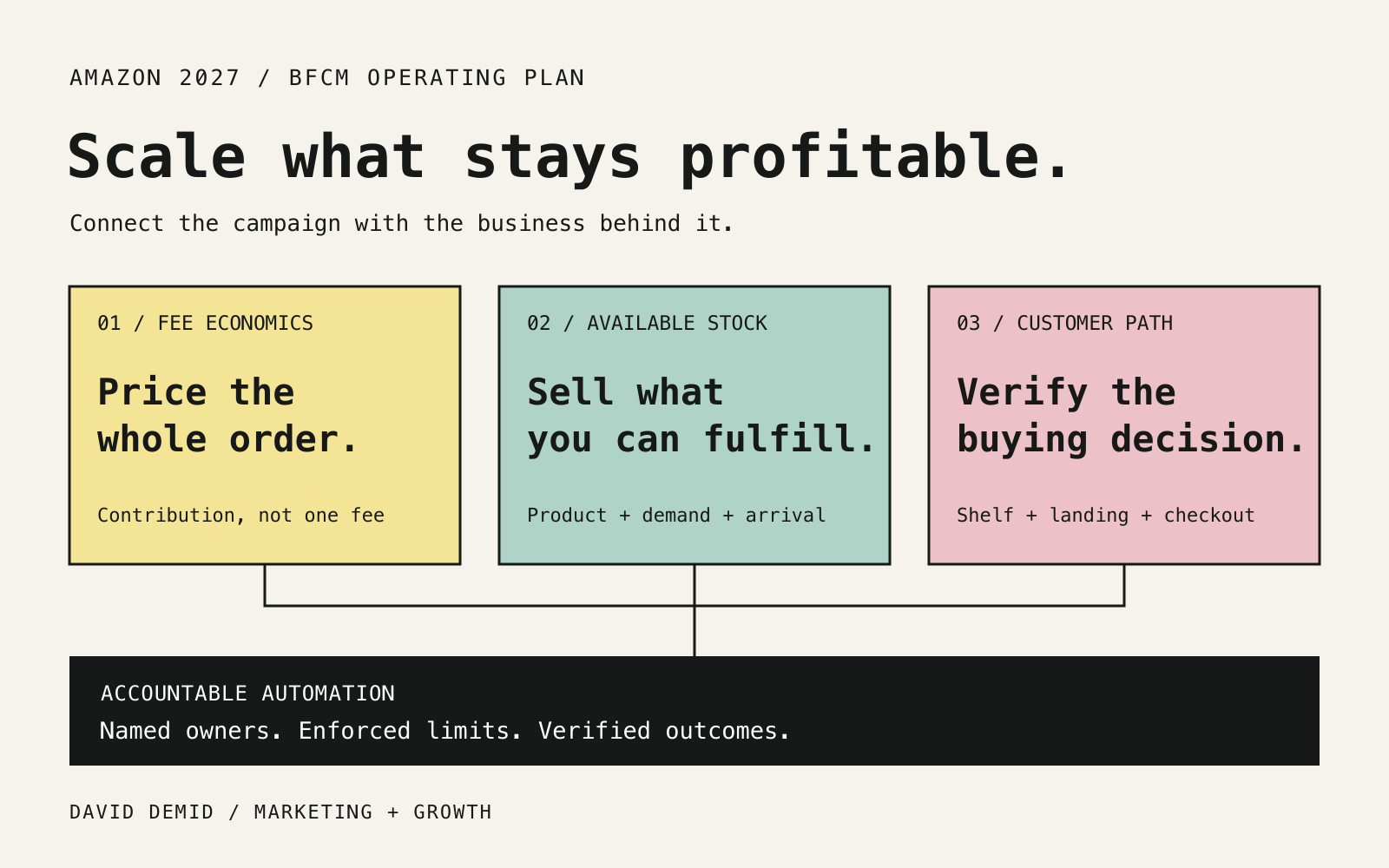
An Amazon external traffic strategy should answer three questions before it buys a click: which product can support acquisition costs, why a particular audience should buy it, and what evidence would justify spending more.
My starting point is the acquisition allowance. I choose the product and the decision boundary before choosing the channel.
The strongest starting point is usually a narrow test, not a launch across every available channel. Choose one product or coherent product family, one audience hypothesis and a defined spending boundary. Then evaluate the result against contribution, not traffic alone.
This guide is for brands with a buyable Amazon offer and a real budget decision to make. If your listing is unavailable or the featured variation cannot be delivered reliably, fix that constraint first.
Start with the acquisition allowance
Revenue is not your advertising budget. What matters is what remains after the costs associated with an order.
For an initial planning model, calculate:
Contribution before acquisition = net revenue − product cost − marketplace and fulfillment costs − other variable order costs.
Use consistent definitions. If net revenue already includes refunds and discounts, do not deduct them again. Include a reasonable returns allowance where the reporting period has not matured. Keep fixed overhead separate, but leave sufficient contribution to cover it.
For an illustrative planning example:
| Item | Per order |
|---|---|
| Net revenue | $40 |
| Product, marketplace, fulfillment and other variable costs | $26 |
| Contribution before acquisition | $14 |
| Contribution you want to retain after acquisition | $6 |
| Maximum acquisition allowance | $8 |
If the test spends $600 on media and $200 on creative attributable to this pilot, it needs 100 genuinely additional orders to meet an $8 acquisition allowance. Attribution reporting alone cannot establish that all 100 orders are additional.
This calculation is a planning boundary, not a promise that the campaign can acquire customers at that cost. If the economics are implausible before launch, choose a different product, improve the offer or do not run the test.
Match the channel to the buying situation
There is no universal best source of external traffic to Amazon. The useful question is where your intended customer can encounter a credible reason to buy.
| Buying situation | Initial hypothesis to test | Main risk |
|---|---|---|
| Customers actively search for the specific problem your product solves | A tightly scoped search campaign | Paying for broad or irrelevant searches |
| A demonstration explains the product better than a headline | A creator or paid social creative test | Entertaining viewers without creating purchase intent |
| An existing, permission-based audience knows the brand | A targeted email campaign | Crediting the campaign for purchases that would happen anyway |
| Customers need to compare a collection | A relevant Brand Store destination | Sending visitors to a general store with no clear next product |
These are test hypotheses, not channel rankings. A search campaign can still bring poor traffic. A creator can bring highly qualified buyers. The message, audience and destination matter together.
Do not divide a small learning budget among four channels simply to call the strategy diversified. Too many moving parts can leave every result inconclusive.
Choose the destination deliberately
A product page is a logical destination when the advertisement makes a specific product promise and the listing can complete the explanation. A Brand Store may be more useful when the customer needs to explore a range.
An intermediate page on your own website can help explain a complex use case, but it introduces another step. It should earn that step by answering a question the Amazon destination cannot answer as effectively.
Check the complete mobile journey before launch. Does the correct variation appear? Is the advertised price still accurate? Is delivery acceptable in the destination market? Does the first visible product information support the creative's claim?
For the offer-readiness side of this decision, see why the delivery promise matters before buying more Amazon traffic.
Write a test brief that can produce a decision
Use this structure before the campaign starts:
- Business question: Can this audience support acquisition of this product within the agreed contribution boundary?
- Product and market: Name the ASIN, variation and destination marketplace.
- Hypothesis: State the buyer problem and the evidence used in the creative.
- Destination: Identify the exact page and why it fits the audience.
- Measurement: Define spend, traffic, purchases, returns and reporting delays.
- Boundary: Agree total spending, stock constraints and who can pause the campaign.
- Decision date: Allow for the applicable reporting window and expected purchase cycle.
The review date is not a requirement to declare success. If purchase volume is too low to distinguish signal from noise, the valid conclusion may be “not enough evidence.” Decide whether more learning is worth its cost.
Use Amazon Attribution without confusing it with causation
Amazon Attribution provides measurement for eligible non-Amazon marketing activity and associated Amazon shopping outcomes. Confirm current eligibility and available reporting for your marketplace and account before designing the test.
Separate tags by the decision you need to make, such as channel, campaign or creative. Keep a register connecting each approved destination to the actual link used. Test those links before launch, including mobile redirects.
Maintain three separate views:
- Source reporting: what you spent and what happened before the shopper reached Amazon.
- Amazon attribution reporting: the purchases and sales credited under that system's rules.
- Total product performance: sales, contribution, returns and availability across the full product scope.
Do not add overlapping platform-attributed sales together. Do not describe all attributed purchases as new customers. Do not treat a concurrent rise in total sales as proof that the external campaign caused it.
Where scale and data permit, design a credible comparison or holdout with an experienced analyst. Otherwise use a documented baseline and explicitly acknowledge confounders such as price changes, promotions, stock recovery and seasonality. A before-and-after comparison is useful context, not automatically an incrementality estimate.
Decide what happens after the test
Increase cautiously when the offer remains available, measurement is usable and the evidence supports the commercial boundary. Monitor whether acquisition costs deteriorate as the audience expands.
Revise the test when the audience responds but the product page fails to answer a key question, or the creative attracts the wrong use case. Change the relevant variable rather than rebuilding everything at once.
Stop when the product cannot support the cost, stock cannot support demand, claims are inaccurate or further learning is unlikely to justify its expense.
The purpose of external traffic is not to prove that a channel works. It is to establish whether a specific acquisition route deserves a role in your business.
Need a decision-ready external traffic plan?
Explore Amazon external traffic consulting or send a project brief. Include the marketplace, a product link, your current channels and the decision you need to make. Anonymized commercial ranges are enough for an initial conversation; do not send account passwords or customer data.
Continue the analysis
- Amazon SKU Rationalization: Which Products Deserve Investment?
- Check the Amazon delivery promise
- Amazon 2027 fees and profit controls
Common questions
Should a new brand start with external traffic?
Only when the offer, economics and measurement support a meaningful test. External promotion does not fix an unclear product proposition or an unavailable listing.
Does external traffic guarantee higher Amazon rankings?
No. Monitor relevant visibility separately, but do not build a budget around a promised ranking improvement.
What is a good starting budget?
There is no reliable universal amount. Work backward from the acquisition allowance, the cost of producing the test and the volume needed to learn something useful. If the affordable test cannot answer the question, change the question or defer it.