A campaign can hit its ROAS target and still leave the business worse off. The advertised variation runs out, a discount removes more revenue than it saves in fees, or an automated agent scales the wrong product.
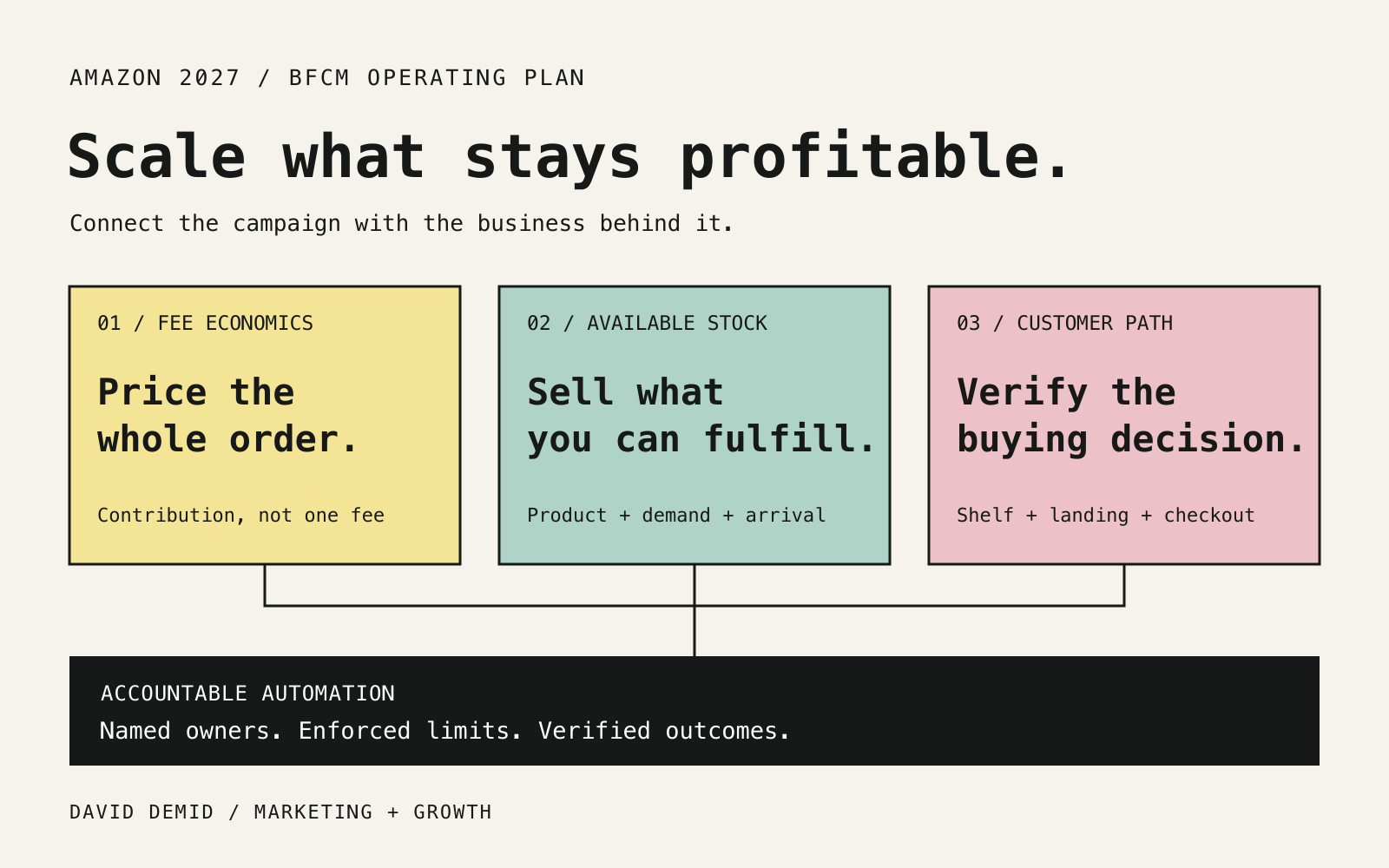
I reviewed Amazon's 2027 fee announcement alongside the latest discussions about listing creative, pre-campaign quality checks and AI-agent ownership. My conclusion is straightforward: the next useful optimization is a tighter connection between acquisition, inventory and contribution, not another isolated campaign adjustment.
November brings two jobs at once. Protect the economics of the holiday trading period, then build a product-level view of what changes under the next fee schedule. Mixing those jobs produces rushed repricing and misleading performance reports.
Here is how I would organize the work.
1. Amazon FBA fee changes need a product-level calendar
Amazon's official 2027 announcement separates the effective dates: most changes begin January 15, 2027; storage restructuring and the revised low-inventory-level fee begin February 1. Amazon reports an average fulfillment-fee increase of $0.19 per unit, but the actual impact varies by product, size and price.
My response is to compare affected products, not apply the average to the whole catalog. I want an effective date, the current fee, the proposed fee and the contribution impact attached to each relevant item.
The same announcement describes replacing the storage-utilization and aged-inventory surcharges with an age-based monthly storage structure. It also changes the low-inventory assessment to consider actual shipments in the four weeks before and after the assessment date, with a 28-day supply threshold. That is a future fee rule, not a reason to reinterpret today's inventory snapshot as an invoice.
For planning, I separate three views:
- Holiday trading: the fees and inventory conditions applying to the orders being fulfilled now.
- Next-year exposure: the products whose economics change under the applicable 2027 schedule.
- Operational decisions: what needs repricing, replenishment, liquidation or a different fulfillment route.
A fee announcement should become a prioritized worklist. It should not trigger a blanket price change while the team is still trying to understand which products are affected.
2. A lower fee is not necessarily a better price
The wrong pricing question is, "Can I move this item below a fee boundary?" The useful question is, "What contribution remains at the new price, and what extra demand would make the change worthwhile?"
An illustrative calculation makes the problem clear: a $2 price reduction that saves $0.50 in fees still removes $1.50 per unit before considering advertising, returns or product costs. A lower fee line does not repair that arithmetic.
I would compare at least the regular offer, the proposed discount and the post-promotion price. For each, use the actual fee basis and the product's size, category and fulfillment configuration. Amazon's pricing resources and Revenue Calculator provide a starting point for those checks.
My decision sheet keeps these inputs visible:
| Decision input | What I want to establish |
|---|---|
| Customer price | What the shopper pays after the relevant offer |
| Fee basis | Which price and product attributes determine each charge |
| Variable costs | Product, fulfillment, promotion, advertising and expected return costs |
| Unit contribution | What remains after the costs included in the decision |
| Required lift | The additional volume needed to offset lower contribution per order |
I would not assume that a coupon changes the price used for every fee calculation. Check that fee's definition, then test the economics. A promotional price and a fee-assessment price are different inputs until the applicable rules establish otherwise.
This also changes how I evaluate channel expansion. A lower headline platform fee can be offset by acquisition, fulfillment or returns. I compare the remaining contribution on a consistent basis rather than label one channel cheaper from a single percentage.
3. Inventory-aware PPC starts with a clean product identity
Before increasing ad pressure, I want to know what is actually available to buy. A low-stock export can contain multiple seller-SKU rows for the same sellable child ASIN. Counting rows is not the same as counting distinct product opportunities.
My operating review starts by reconciling seller SKUs to the correct child ASIN. I keep current FBA availability separate from inbound inventory, and both separate from warehouse stock that has not yet been transferred. Inventory becomes available on a timeline, not because a spreadsheet contains a number.
A simple planning measure is:
Operating stock cover = available units / expected daily unit demand.
The demand assumption matters. I compare the recent selling rate with the campaign plan and relevant seasonal behavior. A trailing average can understate the requirement just before a major sales event. This operating estimate is also separate from Amazon's own fee-assessment calculation.
Then I assign a response rather than send the same low-stock alert to everyone:
- Replenish commercially important products when stock and receiving timelines support the event.
- Adjust the promotional plan when demand would outrun the expected supply.
- Redirect suitable traffic to an available alternative only when the product and customer promise genuinely fit.
- Reduce avoidable ad pressure when no realistic replenishment path exists.
I would review projected contribution and the replenishment date together. Cheap clicks are not valuable if the selected variation cannot fulfill the customer promise.
4. Inbound and launch benefits belong in the same economics model
Inventory decisions are not finished when someone creates a shipment. Receiving dates, split arrivals, placement costs and exceptions can change whether a replenishment plan supports the campaign.
My inbound register includes the shipment-plan date, destination, expected arrival, available supporting documents and the next exception-review date. If a relief program applies, I record its specific eligibility conditions. If a charge contradicts the applicable terms, the owner needs a documented case, not a general reminder to "check Amazon."
For launches, Amazon's FBA New Selection program offers benefits for qualifying new-to-FBA products, including certain fee credits and temporary operational savings. Eligibility and the applicable benefits need to be checked for the actual product and account.
I model a launch twice: once with confirmed temporary benefits and once after they end. That reveals whether the launch is building a viable product or merely looking attractive during an incentive window. Credits can improve a sound launch; they should not hide a weak base margin.
5. Listing images must work on the search shelf
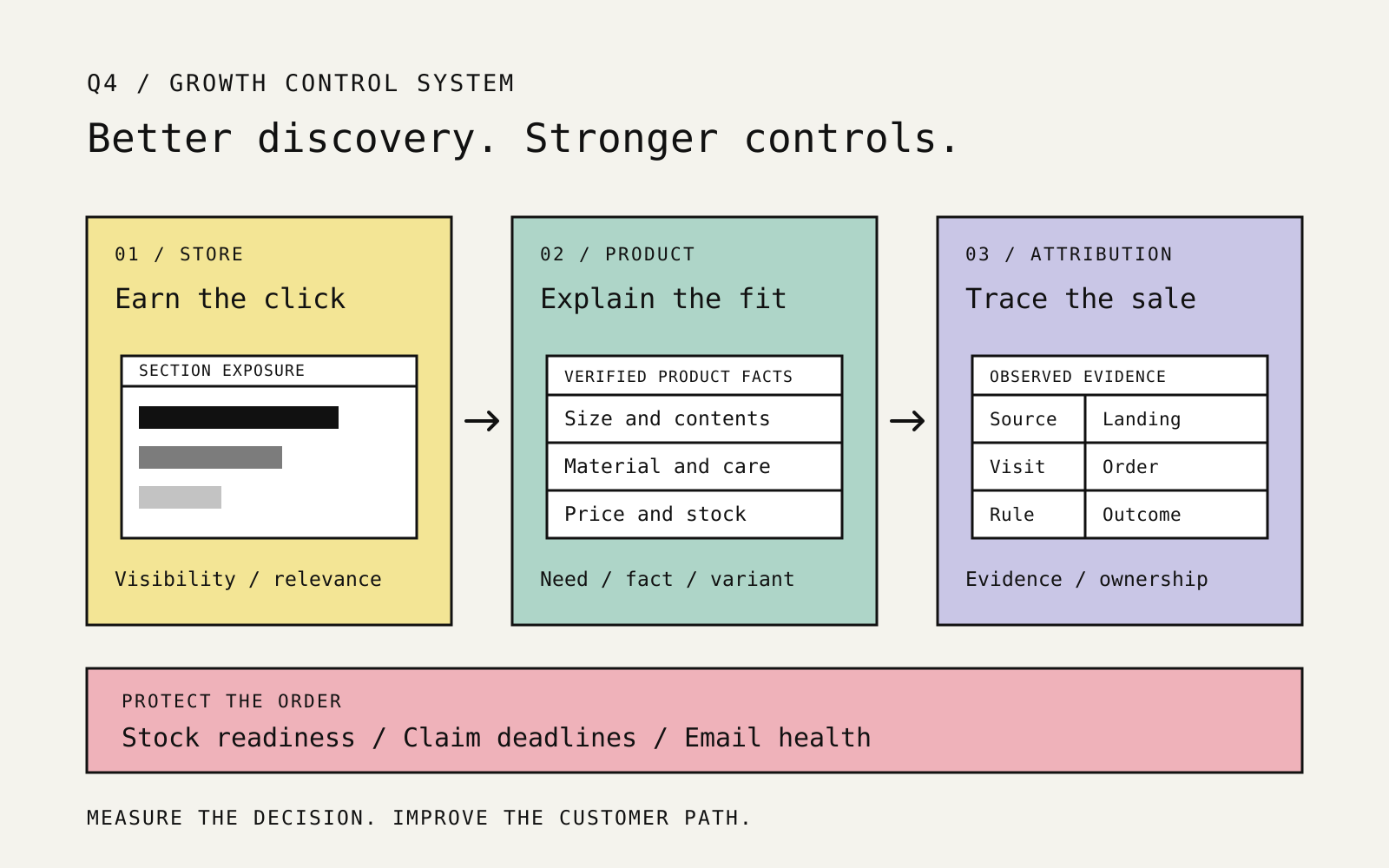
A main image can look excellent in a design review and still be difficult to notice among competing results. It has two different jobs: represent the product accurately and help the relevant shopper recognize a useful choice in context.
The listing discussion in AM/PM episode 570 reinforced a distinction I would keep in any creative test: a head-to-head preference test is not the same as a choice among actual search results.
My next test would use the real target query, device context and competitive shelf. Keep product identity and offer conditions stable, then examine whether the creative improves relevant product discovery and the subsequent buying decision.
I also want the rest of the image sequence to answer the shopper's next question: what is included, whether the dimensions fit, how the product is used and what differentiates it. A brand mark alone does not answer those questions.
Catalog changes need similar discipline. If the account offers detach or ungroup controls, record the original variation structure before using them. Check the live parent-child relationships, offers, availability and policy compliance afterward. A simpler editing tool does not remove the need to verify the result.
6. Pre-campaign QA should end with a tested customer route
I would not release more budget solely because the desktop homepage looks polished. The check needs to follow the campaign: ad, landing page, selected variant, cart and purchase confirmation.
Ani Nandi's pre-campaign review framework makes a useful distinction between evidence-based AI review and actual interaction testing. I would use automated review to prioritize suspected problems, then test the commercially important route myself or assign it to a named reviewer.
For each reported issue, I want a URL, supporting evidence, the affected journey, an owner and a retest condition. A screenshot can support a layout observation. It cannot prove that a payment completed or that an order event arrived correctly.
My release gate is practical:
- Confirm that the advertised item and variation are available.
- Check that the offer continues consistently onto the destination page.
- Test mobile navigation, selection controls and the cart.
- Use an approved test-payment route to check the order flow without creating an unintended live charge.
- Verify the expected measurement behavior, including consent choices and transaction deduplication.
A short, verified customer journey is worth more than a long checklist marked complete by assumption.
7. Give AI agents commercial limits, not just instructions
Once an agent can change an offer, spend advertising budget or edit a catalog, it is operating part of the business. I want its authority designed as carefully as the campaign strategy.
The David Greenberg interview on agent accountability highlights why a prompt is not an adequate control boundary. My implementation principle is to enforce limits in permissions, tools and approval rules, then retain enough evidence to reconstruct each material action.
I would define the following before granting write access:
- A named business owner and a separate operational contact where needed.
- The products, accounts and fields the agent may access or change.
- Spend, price and stock-related boundaries enforced outside the prompt.
- Approval requirements for higher-impact or hard-to-reverse actions.
- Logs, monitoring and a practical way to stop or roll back a change.
The shared commercial objective matters as much as the individual limits. A pricing agent, an ad agent and a replenishment agent can each satisfy their local instruction while producing an undesirable combined result. I would coordinate them around contribution, available supply and customer experience, not three unrelated activity targets.
My operating plan before scaling the next campaign
I would start with a small set of commercially important products, not an attempt to rebuild every report at once.
| Workstream | First deliverable | Review decision |
|---|---|---|
| Fee exposure | Product-level current and 2027 comparison | Reprice, retain or investigate |
| Available supply | Child-ASIN stock and arrival timeline | Replenish, redirect or limit demand |
| Price economics | Contribution at regular and promotional offers | Test the offer or reject it |
| Buying journey | Verified mobile route and event checks | Release spend or fix the blocker |
| Automation | Agent owner, permissions and action limits | Delegate, narrow access or require approval |
My order of work is simple: fix broken buying routes and materially wrong product information first. Resolve time-sensitive supply decisions next. Then test the offer and creative against a stable baseline, with automation kept inside agreed boundaries.
Scale the demand the business can fulfill profitably. Do not use a strong ad metric to excuse a weak operating decision.
If your team needs that connected review, explore my Amazon advertising consulting, Amazon inventory analytics and conversion optimization, or discuss your growth challenge.
Amazon fees, BFCM and automation FAQ
Do all Amazon 2027 fee changes start on February 1?
No. Amazon's announcement puts most changes on January 15, 2027, with the storage restructuring and revised low-inventory-level assessment on February 1. Build the operating calendar from the specific change affecting each product.
Should I lower a price just to cross an FBA fee boundary?
Compare the fee saving with the revenue reduction and the effect on contribution. Establish which price the fee actually uses. A fee saving smaller than the price reduction needs enough additional profitable demand to justify the change.
Is operating stock cover the same as Amazon's low-inventory fee calculation?
No. Operating cover is a planning estimate based on available units and a demand assumption. Amazon's assessment uses its specified rules and periods. Use the former to coordinate advertising and supply; check the latter to understand fee exposure.
What should an AI agent be allowed to change?
Only the scope supported by enforceable permissions, commercial limits, monitoring and an accountable owner. Start narrowly, review actual behavior and expand authority only when the process and recovery path support it.
Source notes
- Research as of November 10, 2026: Amazon's official 2027 US fee announcement, including the distinct January and February effective dates.
- Pricing and product estimates: Amazon selling fees and Revenue Calculator resources.
- Launch economics: Amazon's FBA New Selection program overview.
- Listing context: AM/PM episode 570, listing creative and connected workflows.
- Pre-campaign verification: Practical Ecommerce, Find Site Errors with AI before Ads Run.
- Agent authority and accountability: Practical Ecommerce, Who Owns an AI Agent's Mistakes?.
- The prioritization, decision sheets and operating framework are my analysis. The pricing arithmetic is an illustrative example, not an Amazon fee quotation.