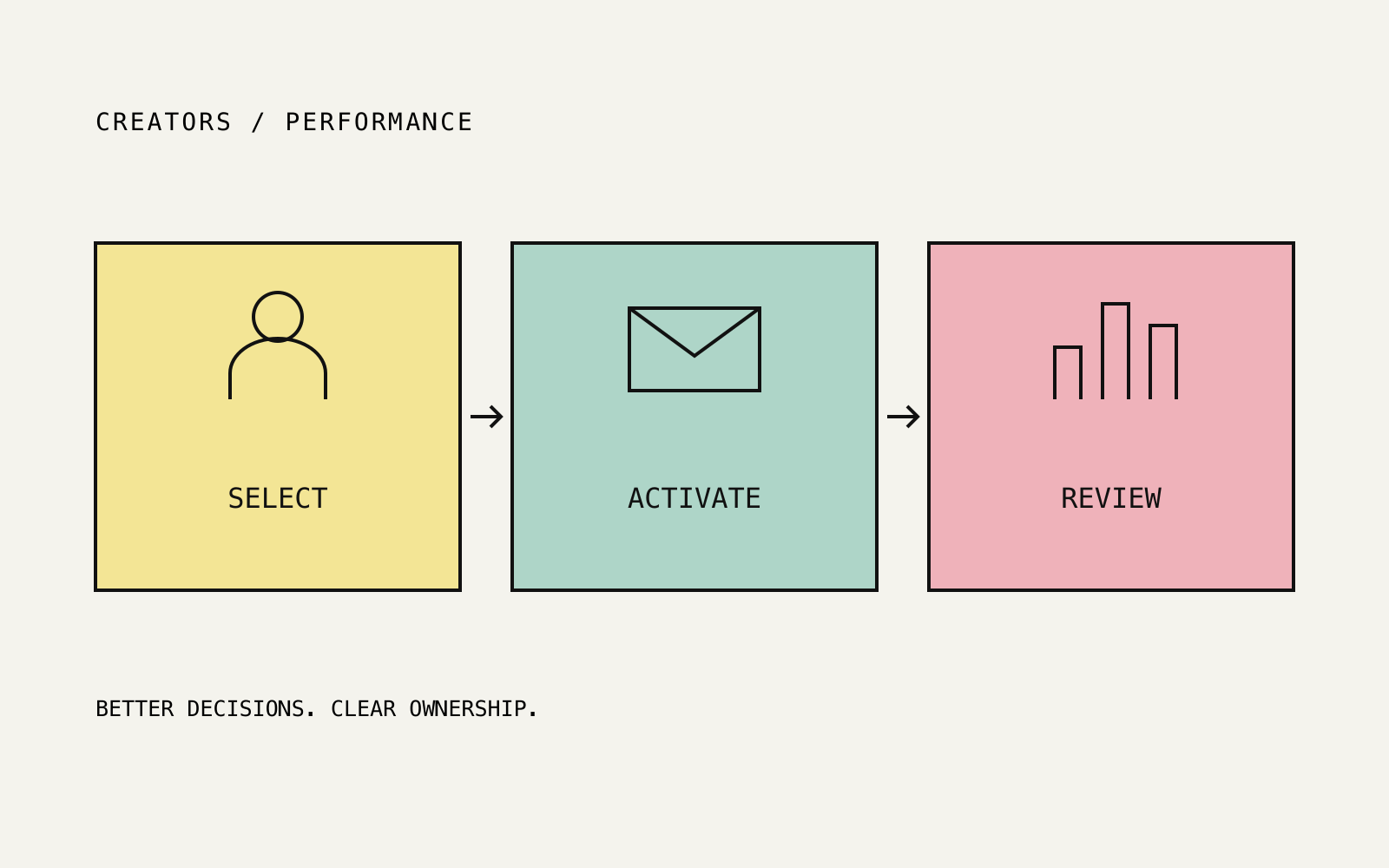
Amazon creator marketing becomes a useful acquisition channel when selection, product readiness, tracking and commercial review work together. Buying reach is easy. Building a repeatable decision about which creator, product and offer deserves another activation is the real work.
My approach starts with the buying journey, not a follower-count target. Who reaches the right customer? What does that customer see next? Does the resulting order support the business objective after the costs of the activation?
What I built: a creator operating system, not just a report
I worked directly with Creator Connections, built systems for managing creator activity and trained employees to run the process. My work covered creator-selection tests, campaign structure, collaboration decisions and performance analysis. Reporting was part of the operating system, not a separate dashboard handed over after the campaign.
One practical approach I use is to identify suitable creators outside Amazon, then bring the collaboration into Creator Connections where the creator is eligible and the campaign fits the program. This connects partner selection with defined products, dates, terms and campaign reporting. It does not mean every external creator can be enrolled automatically.
The campaign description matters. State which products are included, the intended demonstration, commercial terms and what the collaboration requires. Clear conditions reduce repeated questions and make it easier for the team to compare activations on the same basis.
Separate platforms so the next decision is visible
I prefer separate campaign groups for different creator platforms where the program structure allows it. A creator recruited through a short-form video platform should not disappear into the same reporting bucket as every publisher or long-form reviewer.
Record the recruitment platform as an operational label, alongside the creator, product, offer and dates. Campaign grouping alone does not prove which platform caused a purchase: creators may distribute content across several surfaces. Use the available placement evidence and attribution definitions when interpreting the comparison.
The test should produce a decision about whom to keep working with, which product to feature and how to structure the next collaboration. I train the team to document those decisions so the program can keep improving without depending on one person's memory.
Creator activity can introduce products to relevant customers and support their discovery journey. I assess the resulting traffic, attributed orders and product performance; I do not treat participation in Creator Connections as a guaranteed organic-ranking boost.
Start with creators who can move the buying decision
A large audience is not the same as an audience ready to buy the product. I look for relevant product demonstrations, understandable recommendations and evidence that the creator can connect attention with a useful next action.
Previous conversion performance is particularly valuable. When a creator has already produced relevant purchases, the next question is whether that performance can be repeated with the current product, price and stock position. Historical success earns a review, not an unlimited budget.
For a home product, useful creative might show dimensions, material, cleaning or the product in use. For an unfamiliar category, the audience may need an explanation before a purchase recommendation. The brief should match that decision rather than force every product into the same short video.
A real reporting example: sales, orders and commissions
The creator and affiliate report below covers January 2024 through February 2026. It records approximately $9.38 million in sales, 263,200 conversions and $964,800 in commission spend. It also reports a 13.1% share of company sales.
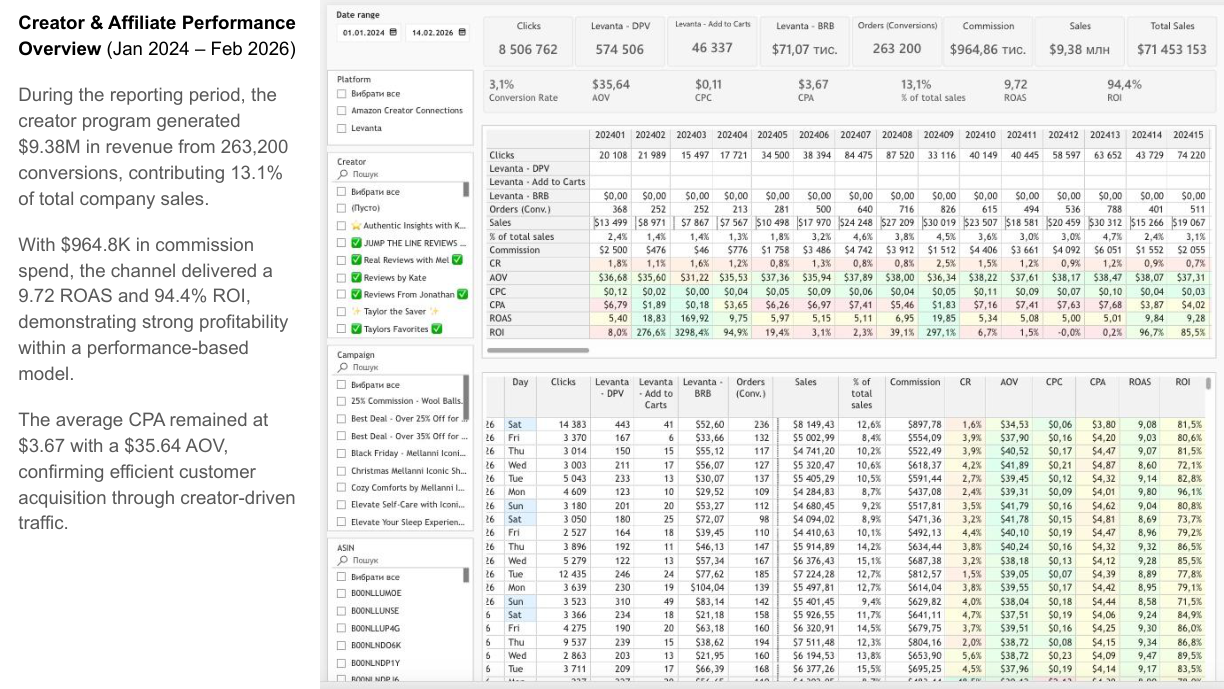
The figures answer different operating questions. Sales describe the channel's reported commercial volume. Conversions describe the reported purchase activity. Commissions describe one part of the cost structure. A share of company sales describes contribution to the reported total, not the effect of switching the program off.
Using the rounded figures, sales divided by commissions is approximately 9.72. Commission per conversion is approximately $3.67, and sales per conversion approximately $35.64. I label those calculations explicitly: a sales-to-commission ratio is not a complete profit calculation.
Before increasing investment, I want product cost, marketplace fees, discounts, fulfillment, returns, samples and any placement fees visible alongside commissions. Otherwise an impressive channel ratio can conceal a weak order contribution.
Separate the creator decision from the product decision
A creator can send appropriate visitors to an offer that is not ready to convert. Review the product page, delivery promise, available variations and promotion configuration before blaming the audience.
I separate three questions:
- Audience: does the creator reach people with a plausible reason to buy?
- Offer: can those people understand the product and purchase it under the advertised conditions?
- Economics: does the resulting order justify the activation cost?
This separation makes the next action clearer. Weak audience fit calls for different selection. A stock or delivery issue calls for an offer repair. Poor contribution calls for a commercial decision, not simply a new piece of creative.
Build a brief that protects product truth
The brief should specify the product, the intended customer, the useful demonstration, approved claims, destination and current offer. It should also make ownership clear: who approves the facts, who checks the link and who updates the creator if the promotion changes?
Consistency matters across the creator content and the Amazon product page. If the video promises a bundle or material feature the landing page does not explain, the customer has to resolve the contradiction. That is avoidable friction.
Keep a record of the approved creative and offer conditions. It makes later performance review more useful than a spreadsheet containing only creator names and total sales.
Review attribution before deciding what to scale
Use the reporting tools available for the activation and record their definitions. A conversion count, an attributed purchase and a unique new customer should not be used interchangeably.
For each activation, keep the creator, destination, reporting period, sales, conversions, commission and other direct costs together. Review cancellations and returns when that information becomes available. Compare periods and products on compatible definitions.
The useful question is what decision the report supports: repeat the placement, change the product, fix the offer, adjust terms or stop. Avoid combining separate dashboards into a supposed channel total until the overlapping attribution has been checked.
Plan for shopping events without depending on instant rankings
Publishers and creators can support Prime Day, Black Friday and Cyber Monday, but the plan should include a practical release check. Confirm the final customer price, overlapping offers, stock, shipping promise, commission and expiry time before sending another wave of visitors.
In my experience, late activations can still be worth pursuing when the partner can publish promptly and already reaches an appropriate audience. That is different from assuming a new article will rank immediately. Existing distribution and audience access are part of the decision.
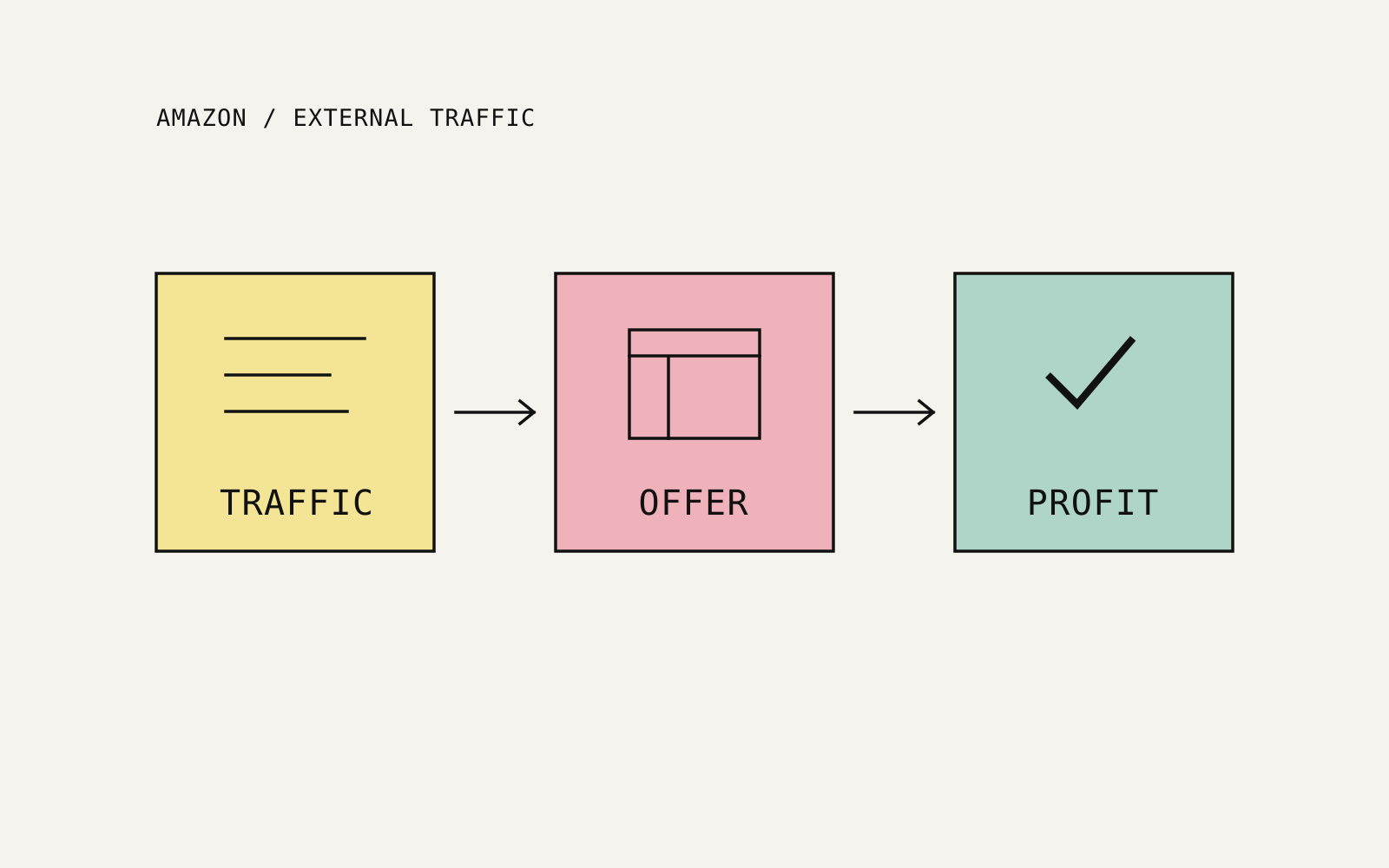
My Amazon external traffic test plan explains how I connect publisher selection with a bounded commercial test. The BFCM promotion audit covers the offer checks before more event traffic.
Make the next activation a deliberate decision
The result of a creator review should be a short action list: repeat, repair, negotiate, test or stop. Assign an owner and a review date to each action. Keep the reason visible so the next campaign does not restart from a follower-count search.
Discuss an Amazon external traffic and creator strategy or book a focused consultation. Bring the product, the current offer and the reporting you already use; we can identify the decision that needs improving first.
Common questions
Should I choose creators by follower count?
Use audience relevance, product demonstration and previous commercial evidence before follower count. Reach matters when it can support a plausible buying journey.
Is a high sales-to-commission ratio enough to scale?
No. Review the complete order economics, offer readiness, stock and whether the attribution definitions are comparable across activations.
Should creator marketing and publishers be managed together?
They can share offer checks, commercial objectives and reporting discipline. Selection and distribution still differ, so preserve visibility into which partner and activation produced each reported outcome.
Source notes
- Research as of November 18, 2026: creator-program reporting for January 2024 through February 2026, reproduced from the original portfolio report.
- Campaign setup: Amazon's Creator Connections campaign guidance covers creator participation, campaign setup and commissions. The operating workflow and team-training approach above describe my own work.
- Ratios above use rounded source totals; sales-to-commission, commission per conversion and sales per conversion are stated separately from profit.