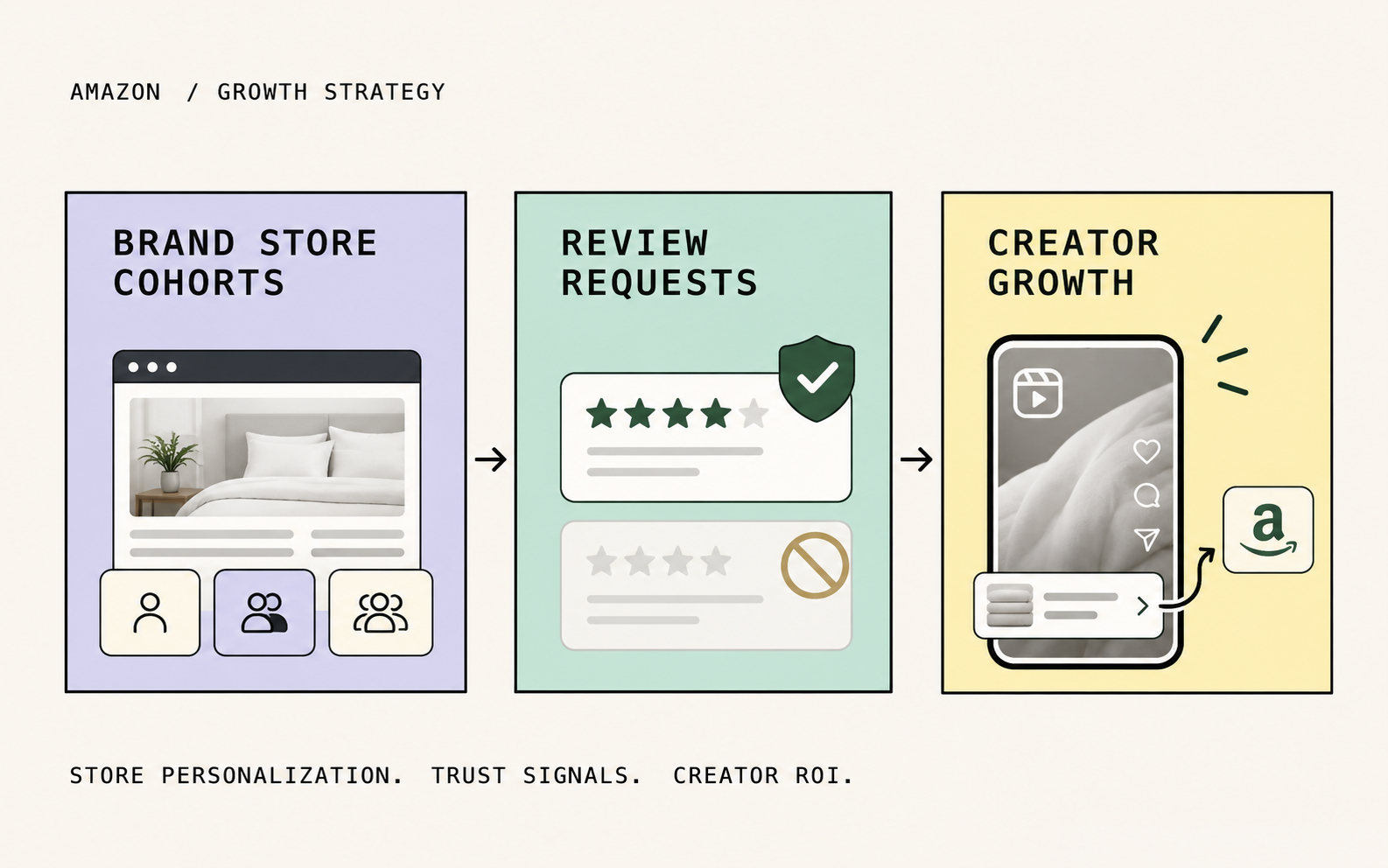
Amazon growth is not always limited by traffic. A brand can spend more on acquisition while sending visitors to a generic Store, promoting a review format to products that cannot use it, and funding creators without checking whether their content produces profitable orders.
For the week of November 23, 2026, I would concentrate on three decisions: make the Amazon Brand Store more relevant to the shopper, filter Review Requests before allocating budget, and turn creator activity into a measurable commerce channel. These are connected decisions, not three unrelated tactics.
My operating rule is simple: make the customer journey work, check eligibility and economics, then scale distribution. Here is how I would apply it to an established Amazon brand.
Three growth decisions before another traffic push
| Priority | What to check first | What makes the test worth expanding |
|---|---|---|
| Brand Store personalization | Shopper cohorts, top-section engagement, orders per visitor and return visits | Better shopping outcomes without sacrificing overall Store conversion |
| Amazon Review Requests | Product eligibility, current bid, rating baseline and contribution margin | A controlled cost per new rating or review, with commercial value beyond the ad itself |
| Instagram and TikTok creators | Audience fit, posting history, offer readiness and complete activation costs | More attributable orders and acceptable contribution, not just more posts |
A growing brand should not treat these metrics as interchangeable. Store conversion is a shopping-experience measure. Reviews are a trust asset. Creator orders are a distribution outcome. They have different costs, different time horizons and different reasons to stop.
Personalize the Amazon Brand Store around buying intent
An Amazon Brand Store should not present the same journey to someone discovering the brand for the first time and to someone who knows the products already. The first shopper needs orientation and evidence. The returning shopper may need a faster route to compatible products, bundles or replenishment.
Amazon has been expanding Store insights, including section-level shopper engagement for eligible accounts. Practitioners have also documented an account-dependent Personalize by Cohort workflow. I would check which tools are actually available in the brand's account before promising a personalization feature to the team.
The useful segments are:
- New-to-brand shoppers: show a recognizable bestselling product, a clear use case, dimensions or material information, and credible proof. Reduce the effort required to understand the assortment.
- High-intent shoppers who have not converted: make product comparison easier. Surface important differences, current availability, a relevant offer and the shortest route back to a suitable product.
- Returning buyers: prioritize complementary products, additional sizes, replenishment and upgrades. Avoid making existing customers work through the same introduction again.
This is merchandising, not merely creative variation. A different hero image will not fix unclear navigation, an unavailable variation or an offer that makes little commercial sense.
The Store experiment I would run
Start with the sections already receiving meaningful attention. Compare traffic sources, visitors, orders per visitor, sales per visitor and section engagement over compatible periods. A section with significant sales concentration deserves an evidence-led experiment before a complete redesign.
I would keep the core destination and measurement definitions consistent, introduce one cohort-specific change at a time where the tools permit it, and record the launch date. If cohort personalization is unavailable, test clearer routing and merchandising on the ordinary Store layout instead.
Then evaluate the result after a suitable observation window. A lift in clicks is not enough if orders per visitor decline. Likewise, an apparent fall in returning-visitor share may reflect seasonality or a surge in new-customer acquisition; inspect absolute counts and source mix before calling it a retention problem.
My decision gate: keep the variation only if it improves a defined cohort outcome without creating a material loss in total Store performance. The evidence needs to justify more Sponsored Brands traffic, not simply provide a nicer storefront.
For the measurement distinction, see my Amazon new-to-brand metrics framework and earlier Brand Store and AI-attribution analysis.
Amazon Review Requests: eligibility before budget
Amazon's Review Requests advertising format, introduced in US beta in 2026, invites recent purchasers to leave a rating or review. It is not the same as the free seller-side Request a Review feature, and it does not buy a positive review.
The first decision is eligibility. Amazon says the advertised product must have fewer than 1,000 total ratings and reviews and that eligibility is rechecked while a campaign runs. The product's campaigns automatically pause at the threshold. Account standing and feature access matter too.
This changes the plan for established brands. A mature bestselling product with thousands of ratings is not a meaningful candidate. Launches and smaller eligible products may be, but only when additional review volume could plausibly address a real conversion barrier.
How I would evaluate a Review Requests pilot
First, confirm availability and eligible products in the actual Amazon Ads account. Do not build a campaign plan from a podcast screenshot or an assumed universal bid. Some November 2026 operator examples report a $2 minimum bid; the current console is the source of truth for the account's bid requirements.
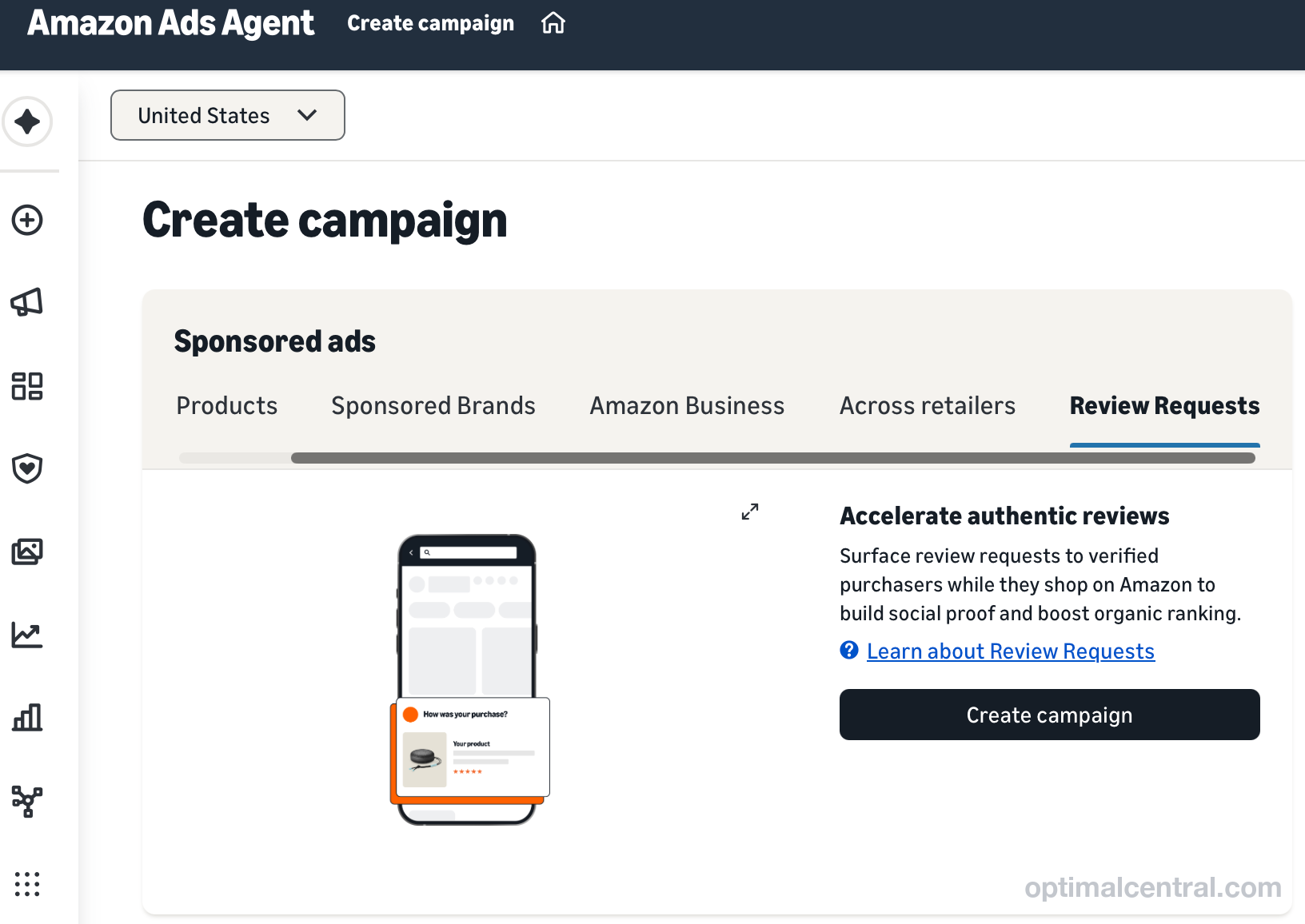
Amazon Ads Agent — Review Requests campaign selection (US open beta, November 17, 2026). Screenshot: OptimalCentral. Interface and availability can vary by advertiser account.
Next, look at the product's rating count, average rating, recent sales volume, current review velocity and unit economics. If the listing has low traffic or an obvious price, content or stock problem, more requests may not be the first priority.
For the pilot, set a small budget and a defined review date. Monitor spend, billable activity, ratings and written reviews reported by the platform, alongside the product's ordinary sales and conversion metrics. Calculate observed spend per new rating or review, but do not call every new review incremental without a credible control or baseline adjustment.
A review ad might accelerate authentic feedback. Its value is downstream product trust, which is harder to measure than a standard attributed sale. That makes a controlled test more important, not less.
My stop rule: pause if eligibility changes, delivery is too thin to evaluate, the economics are outside the agreed limit, or the product itself is not ready to convert. For a mature catalog, free compliant review-request workflows, product quality and listing execution remain important.
Amazon's official Review Requests launch guidance is a better starting point than general promises of cheap reviews.
Instagram Amazon affiliate tagging changes creator distribution
On November 16, 2026, Instagram introduced native Amazon affiliate product linking for eligible creators in the United States. A connected creator can attach up to 30 Amazon products to a Reel or 20 to a feed post, with links directed toward Amazon shopping. Instagram says it takes no cut or transaction fee for this integration.
That is a distribution improvement, not a guarantee of free acquisition. Amazon affiliate commissions, any agreed creator compensation, sample costs, promotions and returns still affect the economics. And a new clickable format does not automatically create an audience that wants the product.
I would first revisit creators already producing relevant content or evidence of purchasing activity, rather than immediately expanding a cold outreach list. Offer a brief built around a credible product demonstration, the actual product variation, the correct destination and a clear explanation of the use case.
Multiple product tags can be useful when the products genuinely belong together: for example, a base product, a complementary accessory and an alternative size. Tagging the maximum number is not the objective. Every extra product should make the purchase decision easier, not distract from it.
Sample discipline matters as much as reach
The same operating logic applies to TikTok Shop affiliate samples. Before approving another shipment, check a creator's posting history, estimated post rate, audience relevance and past product outcomes.
I would consider a 50% estimated post-rate screen as an initial operational filter where that signal is available, not as a universal TikTok requirement or proof of future performance. A creator with a weaker estimate but exceptional product relevance may still deserve an intentional exception. The important thing is to make exceptions visible.
Measure the funnel from invitation to acceptance, sample shipment, published content, qualified activity, attributed shipped orders and post-return contribution. A shipped sample that never results in content is a cost. A video that produces orders at an uneconomic commission is also a cost.
I use separate recruitment and campaign labels so the team can understand where a creator came from and what was actually published. I do not add Amazon attribution and social-platform reports together without checking overlap.
My creator marketing operating framework explains this in more detail; my external traffic test plan covers the commercial checks before sending more off-Amazon attention.
Other signals I would put through the same decision filter
The wider November ecommerce news cycle includes useful developments, but not all of them deserve immediate implementation.
Holiday listing titles: if a seasonal badge or keyword change appears promising, test it on a limited set of relevant products rather than rewriting successful hero listings. Check the customer-facing title, delivery promise and actual offer. An anecdote about a badge appearing is a hypothesis, not a reproducible platform rule.
AI-assisted shopping and business discovery: keep product specifications, availability, certifications and store identity accurate across owned and marketplace channels. New shopping interfaces matter only if they send buyers toward correct, purchasable offers. My earlier AI shopping and attribution article covers why referral and order evidence must remain separate.
Amazon Ads automation and AI agents: compare merchant and advertising account identifiers, verify data freshness, and require human approval for changes with meaningful budget consequences. I prefer change logs and cool-down periods over bid scripts that react to every short-term fluctuation. See my Amazon PPC automation framework.
Refund abuse: review refund-without-return thresholds and evidence handling during peak holiday volume, but preserve legitimate customer remedies. A photograph alone should not automatically decide a high-value claim; neither should an automated fraud flag automatically reject a customer.
Wholesale and B2B ecommerce: a single storefront with authenticated trade prices can simplify inventory and catalog management for some brands. It is a roadmap decision, not a reason to disrupt a retail checkout during the busiest weeks of the year.
I would treat new SaaS promotions and AI tooling deadlines the same way: assign an owner only when there is a defined operational use case, integration plan and measurable benefit.
My practical plan for the next two weeks
| Timing | Decision and owner | Evidence required |
|---|---|---|
| Days 1–2 | Ecommerce owner audits the Store's top sections and shopper cohorts | Cohort definitions, traffic-source mix, orders per visitor and merchandising gaps |
| Days 1–3 | Ads owner checks Review Requests eligibility and pilot economics | Eligible product list, live console bid, rating baseline, budget and stop limit |
| Days 2–5 | Creator owner approaches proven partners and reviews sample approvals | Eligible creators, approved brief, post-rate history, product and commission terms |
| By end of week 1 | Publish one bounded Store test and launch only qualifying campaigns | Exact change log, clean baseline, product readiness and named reviewer |
| After approximately 14 days | Review the experiment rather than declaring victory from early activity | Store shopping outcomes, review costs, creator posts, attributed orders and contribution |
That schedule is a management framework, not a guarantee that every account receives the same beta features or that a two-week test reaches statistical significance. Low-volume cohorts may need a longer observation window.
I want one owner for each decision and one place where the team records what changed. The review should produce scale, revise, continue observing or stop. A dashboard that cannot support one of those decisions is not yet an operating system.
Make growth investments earn the next step
For an established Amazon brand, these opportunities are most useful together. The Store should help different shoppers choose. Review advertising should focus on products that are eligible and commercially ready. Creators should introduce those offers to relevant audiences with costs and attribution visible.
I would not scale a channel merely because the platform added a feature. I would scale when the customer experience, product economics and reporting support the next investment.
If your team needs this kind of connected review, explore my Amazon growth and external traffic work or arrange a focused consultation. Bring the Store performance, product-level margins and creator results already available; the goal is to identify the next decision worth making.
Common questions
Can every Amazon Brand Store personalize by cohort?
No universal access should be assumed. Check your account for Personalize by Cohort and section-level insights. The underlying principles—clear routing, relevant merchandising and cohort-aware measurement—still apply without those features.
Are Amazon Review Requests worth using for established products?
Only eligible products can use the format, and Amazon's published threshold is fewer than 1,000 total ratings and reviews. For mature high-review products, focus on other product and customer-experience levers.
Is Instagram's Amazon affiliate integration free for brands?
Instagram says it does not charge a transaction fee or take a commission from this integration. That does not eliminate Amazon affiliate commissions, creator fees, sampling, discounts or other brand costs.
What should I measure before scaling creators?
Published content, attributable shipped orders, commission and sample costs, returns and contribution. Keep attribution definitions consistent and assess the offer as well as the creator.
How long should a Store or creator test run?
Long enough to collect a meaningful sample and account for reporting lag. I use a roughly 14-day initial review as an operational checkpoint, not an automatic statistical verdict; slower products and smaller audiences need more time.
Source notes
- Research as of November 23, 2026. The priority sequence is my analysis of current platform changes and an operating review. Confidential company-specific metrics and identifiers are intentionally excluded.
- Brand Store insights: Amazon Ads, section-level engagement insights (beta); Amazon Ads Brand Store best practices. For a practitioner account of cohort personalization and its limitations, see AM/PM Podcast #568.
- Review Requests: Amazon Ads launch announcement and Amazon Ads product overview. A reported $2 bid floor is not treated as a platform-wide guaranteed minimum.
- Creator commerce: TechCrunch, November 16, 2026, reporting Instagram's Amazon linking limits and fees. The sample-screening thresholds and decision gates above are my proposed operating controls, not published universal platform rules.