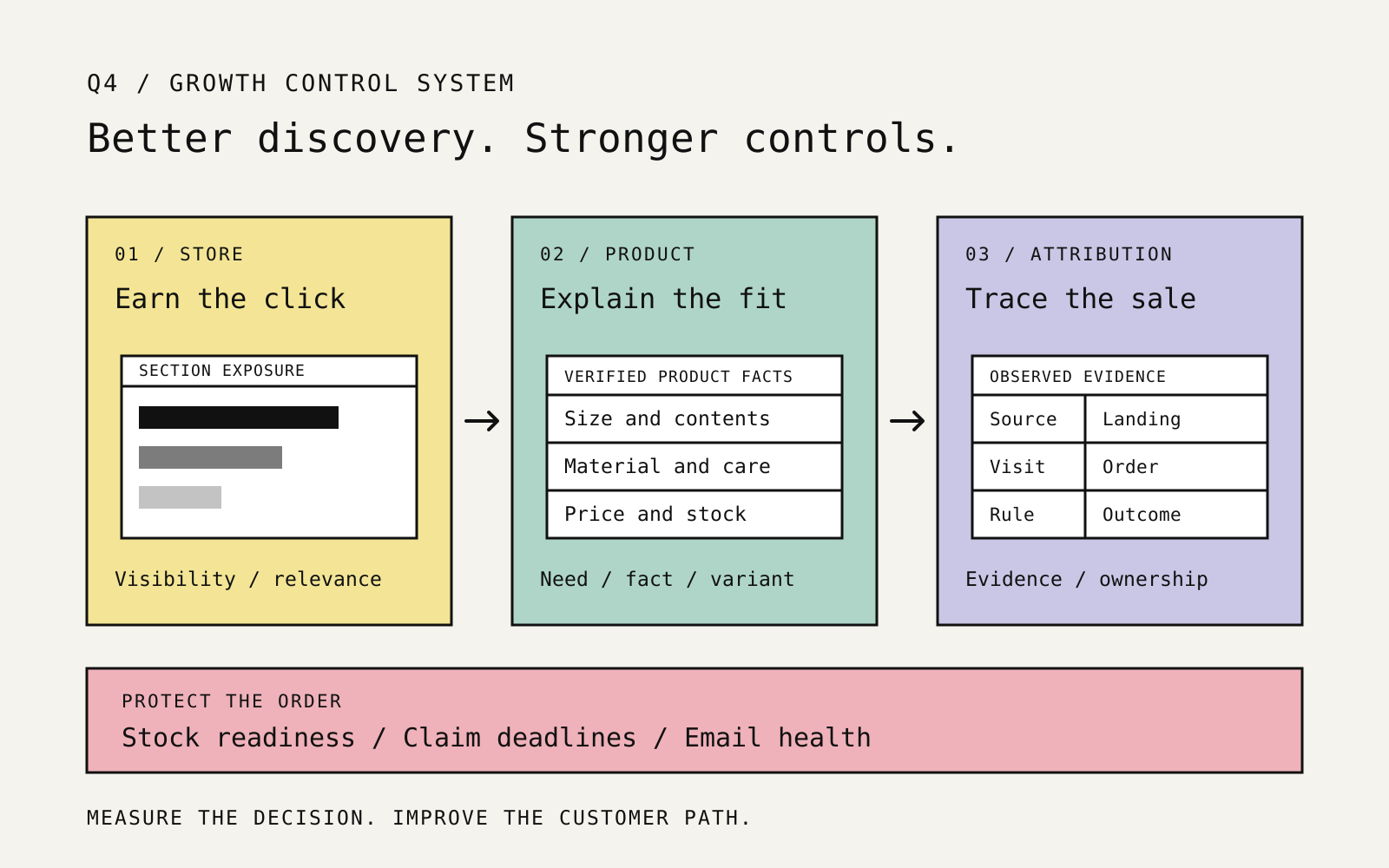
The next growth opportunity is not necessarily another campaign. It may be a better product choice, an order your analytics cannot explain, or an operational loss nobody owns.
I reviewed the latest developments in Amazon Stores, AI shopping, referral measurement and holiday retention. My conclusion: the advantage goes to teams that connect customer discovery with product evidence and commercial follow-through.
A Store redesign should help the right customer choose. An AI recommendation should identify the correct product. An attribution report should follow a real order. An inventory exception should reach someone before its filing window closes.
Here is how I would turn those priorities into an operating plan for November.
1. Amazon Brand Store optimization starts with exposure
A long Brand Store is not automatically a useful Brand Store. Before changing the layout, I want to know which sections shoppers actually encounter and what those sections help them do.
Amazon's section-level Store Insights provides renders, viewable impressions, clicks and CTR by section, with traffic-source context. That makes it possible to review the page below its overall sales total.
I separate two questions: did the shopper see this section, and did the section earn a useful response? A low-click block near the bottom may have an exposure problem. A heavily viewed collection with weak response needs a different explanation.
My first review looks like this:
| Observed pattern | Question to answer | First useful change |
|---|---|---|
| Important content has little exposure | Is the information too far from the relevant entry point? | Move a concise version nearer that journey |
| A section is seen but rarely clicked | Is the proposition, image or destination unclear? | Test a sharper buying choice |
| A section earns clicks but the route stalls | Does the next page continue the same promise? | Fix the product selection or destination |
| Traffic sources behave differently | Are shoppers arriving with different intent? | Review the landing route before blending results |
I use the platform's metric definitions rather than interchange renders, viewable impressions and unique visitors. If I calculate a separate rate, I label its numerator and denominator explicitly.
Then I improve one commercially important route. Put the strongest product decision within reach, reduce competing messages and preserve a clear path to the right variation. The outcome I want is better customer progression, not a shorter page for its own sake.
2. Personalization needs a buying hypothesis
Personalization becomes useful when it answers a question a generic experience handles badly. It is not an excuse to create more banners.
I start with the shopping task: a first-time buyer comparing the range, a returning customer finding a familiar product, or someone evaluating a gift. Those are different information needs. They are not automatically the same thing as a membership or purchase-history label.
Where the account offers cohort controls, I would test a specific change against a stable experience. For example, the hypothesis might be that a returning customer benefits from a faster route to an established collection, while a new shopper needs a clearer comparison.
Keep the offer, product availability and unrelated creative changes controlled. Review the cohort definition, the experience actually delivered and the downstream result together.
If I cannot explain why the customer should find the next step easier, I do not have a personalization test yet.
3. AI-shopping visibility depends on product evidence
AI shopping shifts part of the discovery task from matching a short keyword to answering a buying question. Product information must support the answer.
Amazon describes Help Me Decide as using shopping context, product details and customer reviews to explain its recommendations. My practical response is to audit whether the product can be understood consistently across its content and variations.
For a bedding range, I would check:
- Whether each size and included-piece count is unambiguous.
- Whether mattress-fit information identifies the relevant product and variation.
- Whether material and care information agree across the listing, images and other product records.
- Whether a use-case claim is supported by the actual product, rather than borrowed from enthusiastic review language.
- Whether the recommended option is currently buyable at the displayed price.
Reviews are valuable research into customer language and unresolved questions. They are not permission to turn every customer observation into a verified product claim. If customers repeatedly describe a fit problem, the useful action may be clearer specifications or a product correction, not more persuasive copy.
I would build a small set of representative buying tasks and record the answer, selected variation and supporting facts. Repeat the review after a meaningful content change, keeping the task wording and context visible.
My target is an accurate, useful recommendation. A generic attempt to get mentioned more often can miss the more expensive problem: being recommended for a use case the product does not actually serve.
4. Separate agent readiness from a platform migration
Agentic commerce is becoming an implementation question, not only a content trend. But the first decision is still the customer journey.
Shopify's Shop MCP announcement describes tools for catalog discovery, carts and Shop Pay checkout through an agent connection. The important distinction is between making products understandable and supporting the actions required to buy them.
For a brand considering an agent-assisted route, my acceptance test covers four things: the correct product, the correct variant, current commercial information and a valid checkout path. I also want an unavailable item handled clearly rather than silently replaced with a different offer.
I would verify the proposed route against the actual platform, integration and customer authorization flow. A technology announcement is not evidence that every store already has the same live capabilities.
This does not make a framework migration the default project. Clean product records, dependable variant selection and a working purchase path can be more consequential than changing the front-end stack. Solve the commercial and data constraints before choosing a larger technical rebuild.
5. Measure ChatGPT referrals at order level
An AI-referral report built only from referrer domains can undercount the traffic it is supposed to explain.
In Practical Ecommerce's report on Spanish florist Persa Flores, the merchant identified ChatGPT-linked orders using first- or last-visit evidence. The article reports that tagged landing URLs were much more common than a matching referrer: only about one in eight of those orders also showed ChatGPT as the referrer. The reported order share was 21% in September and 23% through October 27.
That is a useful measurement lesson, not a target I would assign to another brand.
I keep observed source evidence separate from the reporting model that uses it. OpenAI's publisher FAQ documents utm_source=chatgpt.com on referral URLs from ChatGPT search. Browser referrer-policy rules can restrict or omit referrer information. A missing header therefore needs investigation, not an automatic label of either AI or non-AI traffic.
My attribution brief records the safe landing path, observed campaign parameters, referrer when available, timestamp and an appropriate order or lead reference. It also specifies the attribution window and the rule for first-touch, last-touch or assisted reporting.
The operational controls matter:
- Preserve permitted source context through the inquiry or purchase handoff.
- Remove personal data and sensitive URL parameters before sending analytics events.
- Distinguish crawler requests from customer sessions; a bot visit is not a conversion.
- Deduplicate by order or lead identity before comparing channel totals.
- Keep a missing source classified as unresolved unless other evidence supports a decision.
Server-side collection can preserve evidence the system receives. It cannot reconstruct information that was never sent, and it does not replace consent or a defined data-use purpose.
For an implementation review, I want to follow a sample order from landing to the commercial record. A source label is useful only if the team can explain how it was assigned.
6. Intent-specific pages should complete the buying answer
The same florist report says 84% of ChatGPT customers first arrived on a city page. The pages explained the relevant delivery offer rather than act as empty location labels.
My takeaway is about answer quality. A shopper asking for a specific service in a specific place needs a page that resolves that request: what is available, who it serves, the relevant conditions and the next step.
For a remote consultancy, the geography works differently. A Canadian team seeking Amazon US support needs to understand the selling marketplace, reporting scope and collaboration model. It does not need an invented local-office story.
That is the logic behind my service market briefs and Amazon advertising market pages: connect the service to a real customer context, then make the project scope and contact route clear.
I would expand the architecture where the buying question genuinely differs. I would not treat another country's name on the same paragraph as an additional customer answer.
7. Put FBA reimbursements on a case-type clock
Inventory controls belong in a growth plan because lost stock, unresolved adjustments and missed claim opportunities affect the economics the marketing team is trying to improve.
The practical rule is to track the clock for the actual case. Amazon's FBA reimbursement policy and its official claim-window guidance distinguish different event and claim types. I would not manage inbound discrepancies, warehouse loss, customer returns and valuation disputes as one generic deadline.
My operating register includes the marketplace, case type, event date, applicable eligibility and filing dates, units, evidence, reimbursement status and responsible owner. The deadline comes from the current applicable policy, with its reference recorded alongside the case.
I would run a weekly exception review and more frequent alerts for cases approaching their next action date. That is an operating cadence, not a substitute for the policy's own clock. Some cases need evidence prepared now but must be submitted only after the relevant eligibility point.
Before filing, reconcile stock restoration and reimbursement records so the team is not chasing an already resolved event. After a decision, reconcile the outcome and any remaining next step.
The handoff should be precise: this event, these units, this evidence, this owner, this deadline. My Amazon inventory analytics service connects those operating questions with the wider product and acquisition review.
8. BFCM email needs buying signals, not a bigger blast
The wrong response to a late holiday plan is to compensate with indiscriminate volume.
Practical Ecommerce's late-BFCM plan prioritizes a clear offer, a focused sequence, engaged customers and functioning automated flows. I agree with the operating principle: give each message a job and inspect the purchase route before increasing exposure.
I would review recent clicks, purchase history, category interest and current shopping behavior together. A 30-, 60- or 90-day view can help organize analysis, but an opener label alone is not my definition of buying intent.
Then I check the conflicts. A recent purchaser should not receive a contradictory promotion because a scheduled campaign ignored the post-purchase flow. A cart message should lead to an accurate price and available variation. An early-access promise needs a real advantage and a working destination.
I also verify sender setup and unsubscribe handling against Gmail's sender guidance, rather than assume a well-designed email will reach the inbox.
Evaluate completed purchases and contribution alongside unsubscribes, complaints and delivery signals. If I am testing additional messages, I want an appropriate comparison group so the team can assess whether the extra pressure earned useful incremental business.
The goal is a better sequence for relevant customers, not the largest possible send.
9. Use one control sheet for the next two weeks
The fastest way to lose these findings is to turn them into separate unowned projects. I would begin with one decision sheet:
| Workstream | First useful output | Accountable owner |
|---|---|---|
| Brand Store | One exposure and destination diagnosis | Ecommerce lead |
| Product evidence | Verified facts for priority variants | Product and content owner |
| AI attribution | A traceable sample of orders and source rules | Analytics lead |
| Inventory claims | Case register with next dates and evidence | Operations owner |
| BFCM email | Reviewed audience, flow and offer sequence | Retention lead |
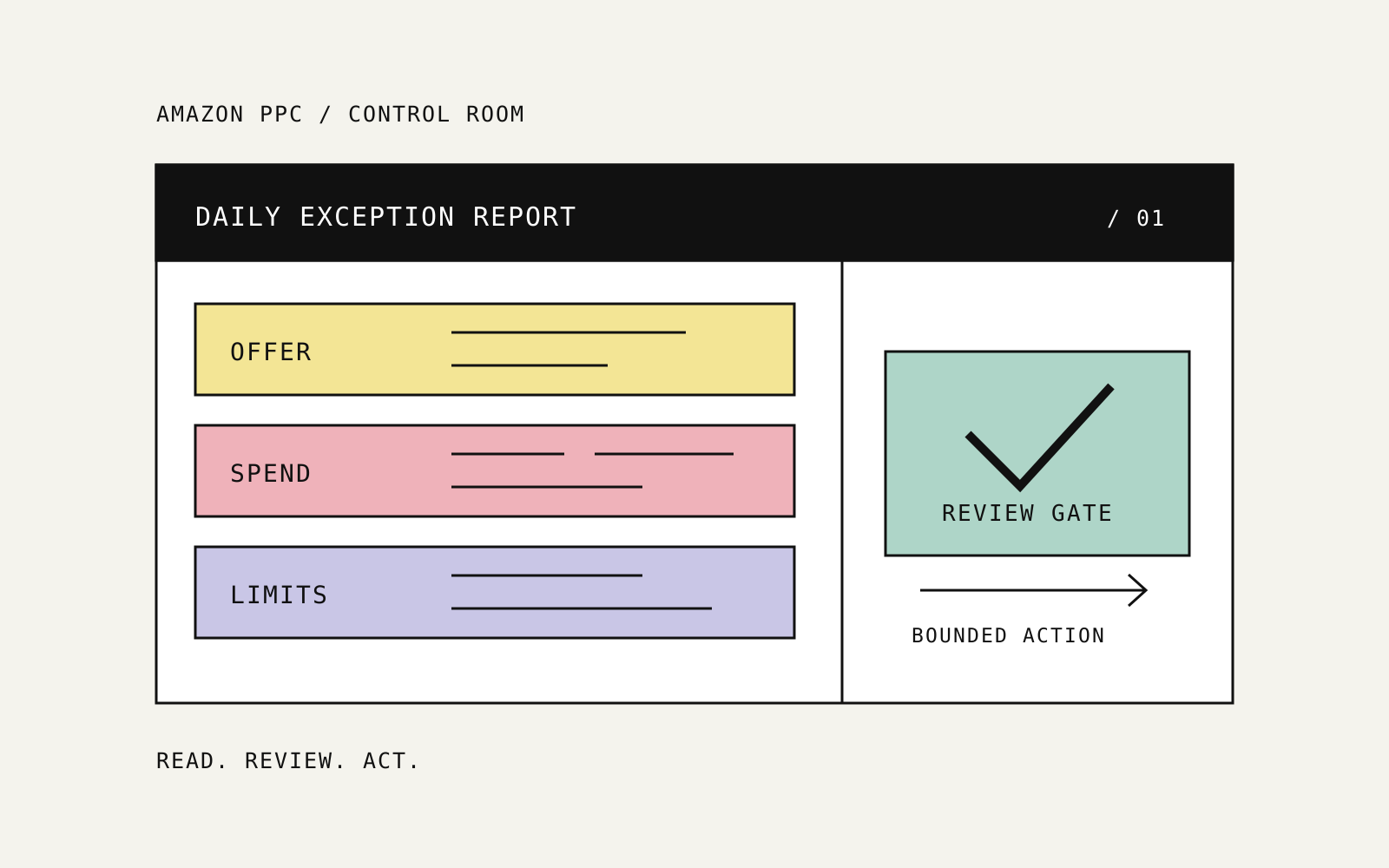
Fix materially wrong information and broken customer routes first. Resolve time-sensitive inventory exceptions next. Then test changes to discovery, conversion or message frequency with a defined question and a comparable baseline.
For each change, record the affected products or audience, the hypothesis, owner, implementation date, exposure boundary and review condition. Keep unrelated changes separate where possible so the team can interpret what happened.
A useful two-week cycle ends with decisions: continue, correct, expand or stop. It should not end with a bigger dashboard and the same unanswered questions.
My decision rule for Q4 growth
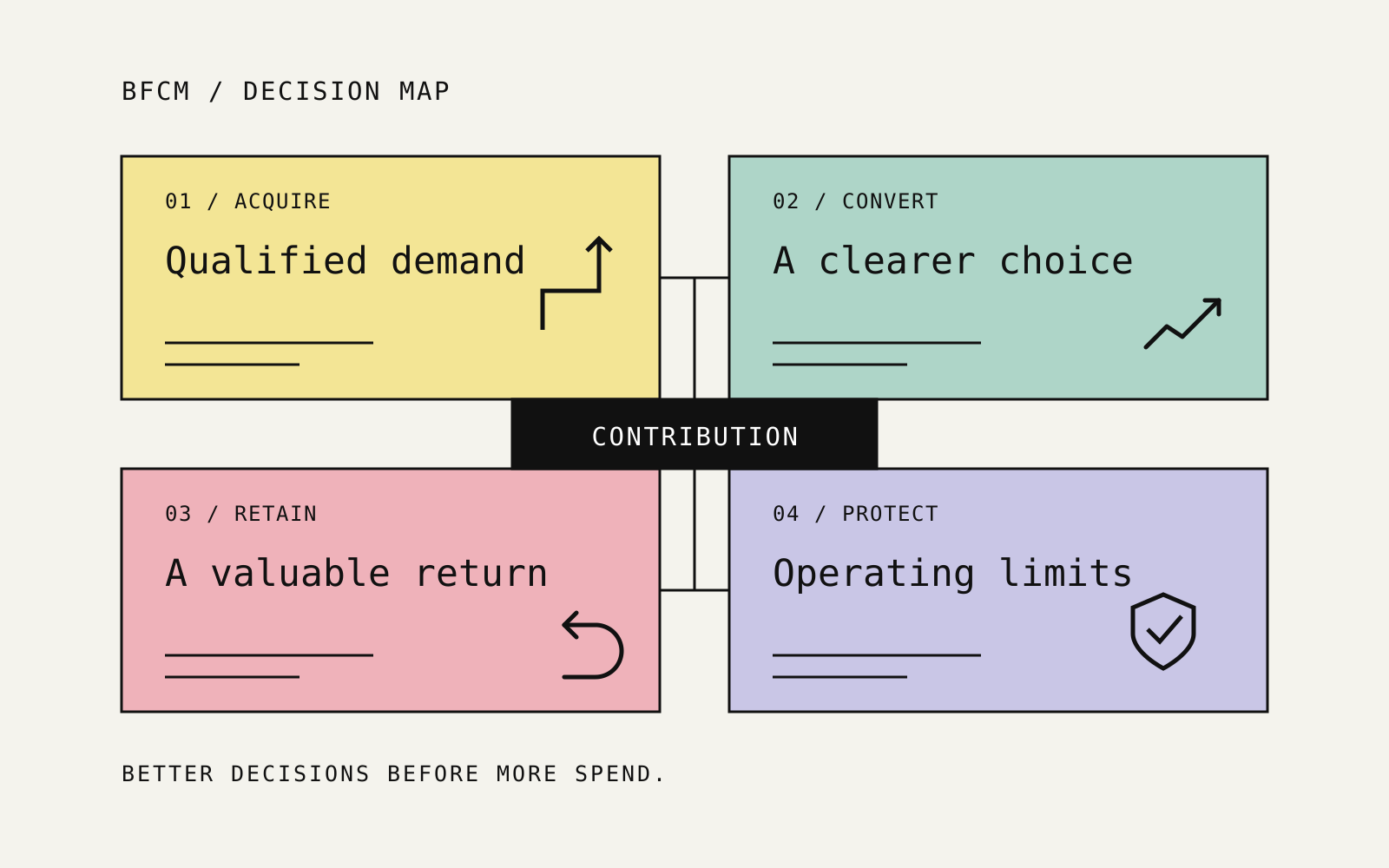
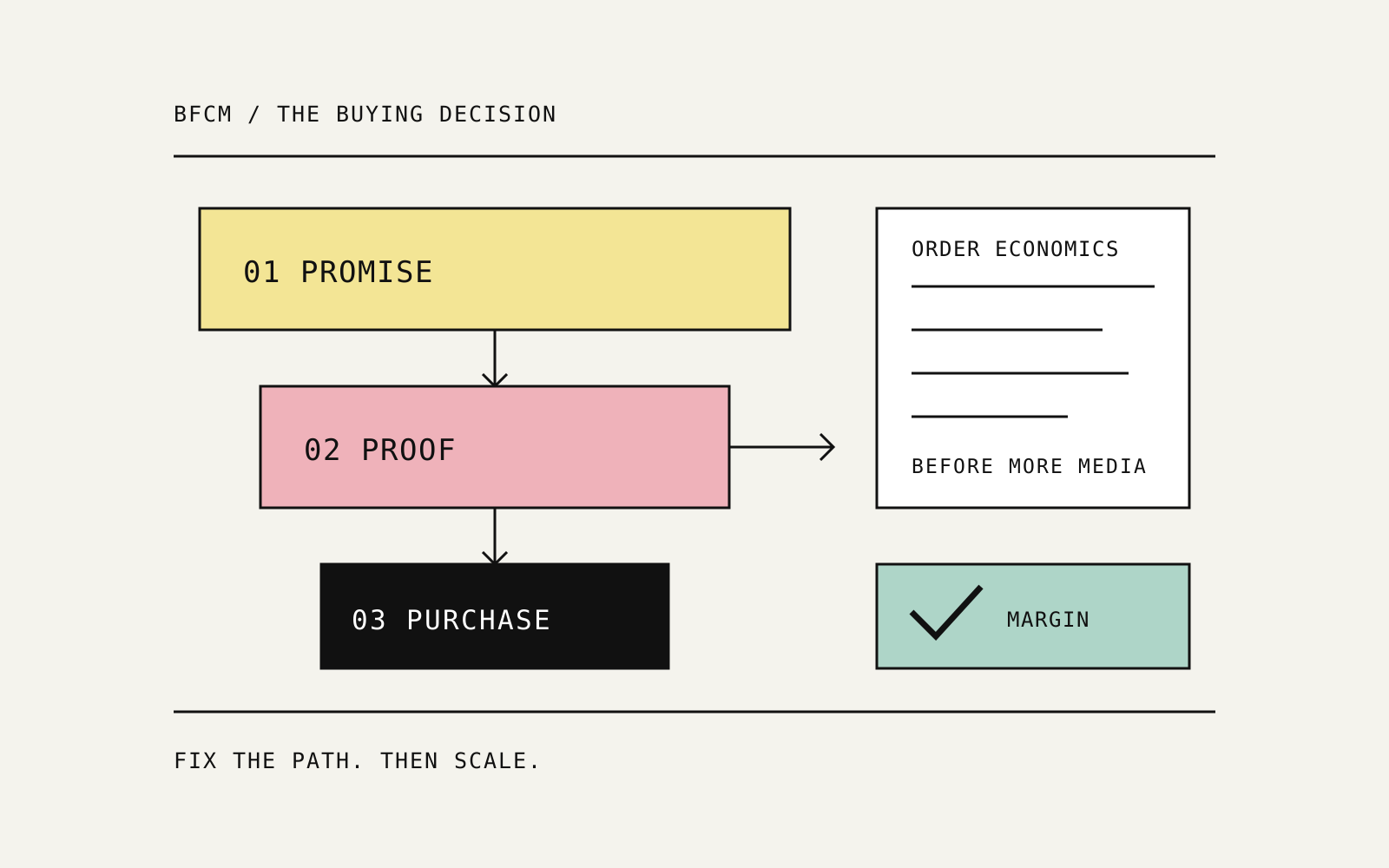
I want three things connected: the promise customers see, the product they can actually buy and the commercial record that tells us what happened.
Brand Stores, AI recommendations and email can all improve discovery. They can also amplify an unclear offer or hide weak economics behind attractive activity metrics. That is why I review the customer path and the operating controls together.
More growth should mean more valuable customer demand, with fewer avoidable failures between interest and a completed, correctly fulfilled order.
If your team needs that connected review, explore my Amazon advertising consulting, conversion optimization and marketing and sales analytics, or discuss your growth challenge.
Amazon growth and AI-shopping FAQ
How do I decide which Amazon Brand Store sections to change first?
Compare exposure with response and review the traffic source. A section that few people see has a different problem from a visible section with weak clicks. Check the destination before interpreting a click as successful customer progression.
How should a business track ChatGPT-driven orders?
Preserve permitted source parameters and available referrer evidence, then connect them with orders using a documented attribution rule. Keep first-touch, last-touch and assisted views distinct. Missing referrer data alone does not prove or disprove an AI-assisted journey.
What product content matters for AI-shopping readiness?
Start with accurate variant identity, dimensions, included items, materials, current price and availability. Explain genuine use cases with supported facts. Check whether a representative buying question leads to the correct product and a valid purchase route.
Should every FBA reimbursement issue use the same deadline?
No. Identify the marketplace, claim type, relevant event date and applicable policy. Record eligibility and filing dates separately where needed, then assign evidence preparation and the next action to a responsible owner.
Source notes
- Brand Store measurement: Amazon Ads, section-level shopper engagement insights, including renders, viewable impressions, clicks and source context.
- Product evidence and AI recommendations: Amazon, Help Me Decide, on product details, reviews and shopping context.
- Agent-assisted commerce: Shopify, Shop MCP, on catalog, cart and checkout capabilities.
- Order-level AI referrals: Practical Ecommerce, Persa Flores' published account. The figures above describe that merchant and its attribution method.
- Referral evidence: OpenAI, publisher FAQ and MDN, referrer-policy configuration.
- Inventory controls: Amazon's US FBA reimbursement policy and official claim-window guidance.
- Holiday retention: Practical Ecommerce, late-BFCM email planning and Gmail, email sender guidelines.
- Execution framework: the prioritization, test design and operating controls are my analysis and recommendations.