Amazon new-to-brand metrics help answer whether reported purchases come from customers who have not bought from the brand during the defined lookback period. They add an acquisition perspective to an advertising review, but the useful decision still depends on the report, the denominator and the economics of the order.
I use new-to-brand reporting alongside total sales, product contribution and repeat buying. A high acquisition share can be valuable. The next question is which products and campaigns bring those buyers at a cost the business can sustain.
What does new-to-brand mean on Amazon?
For the Amazon Ads purchase metrics described in its reporting documentation, Amazon reviews the shopper's previous 12 months of purchase history with the brand. A shopper without a purchase from that brand during that period is treated as new-to-brand for the qualifying purchase.
That is a brand-level purchase-history definition. A buyer can already know the product, have bought from a competitor or have purchased the brand outside Amazon. The metric describes the history Amazon can evaluate for that report; it is not a survey of everything the customer has ever done.
The practical step is to record the exact metric name and the reporting surface before comparing results. New-to-brand purchases, sales, units and detail-page views are different measures. New-to-Store visitors describe another behavior again.
Read the actual category report
The original portfolio contains this category view for April 1-30, 2023. The right-hand column is labeled % Sales new-to-brand, not the percentage of unique new customers.
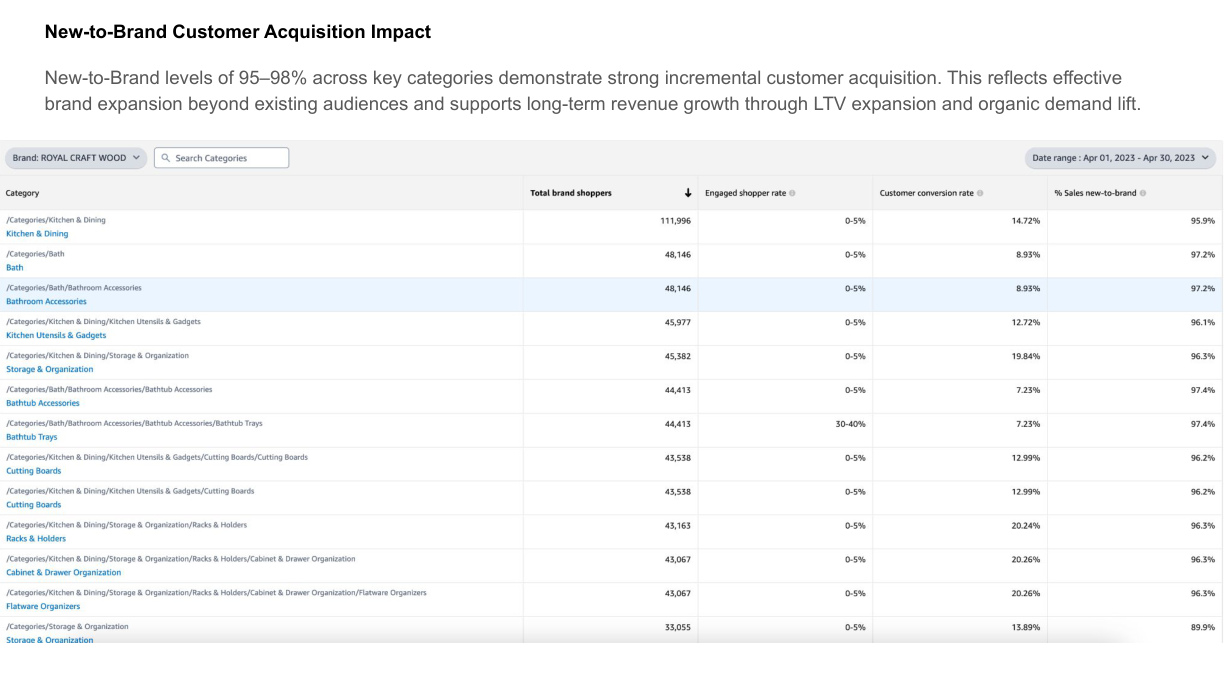
Several visible category rows show sales new-to-brand shares between 95.9% and 97.4%. Another Storage & Organization row shows 89.9%. Those differences are more useful than reducing the entire report to a single impressive percentage.
I read this as a category-level acquisition question: which product groups are reaching buyers without recent brand purchase history, and what happens to the economics and future relationship after that first order?
The categories also overlap. A parent category and its child category should not be added together as independent audiences. Preserve the hierarchy and the metric's denominator when preparing a summary.
Connect acquisition share with acquisition volume
A percentage can rise because new-to-brand activity increased, because repeat activity declined, or because the product mix changed. Start by reviewing the underlying sales or purchase counts alongside the share.
For example, 90 new-to-brand purchases out of 100 purchases gives a 90% purchase share. If the next period records 90 out of 120, acquisition volume is unchanged even though the share falls to 75%. This is an illustrative purchase calculation, not a reinterpretation of the sales-based screenshot above.
Keep share and volume together so a healthier repeat-buying business is not penalized merely for producing a lower acquisition percentage.
Compare ROAS, new-to-brand and contribution
ROAS answers how much attributed sales value is reported per unit of advertising spend. New-to-brand adds a view of recent brand-purchase history. Contribution asks what remains after the relevant order and acquisition costs.
I want all three perspectives available before recommending a budget change. A campaign can produce a large new-to-brand share while attracting low-contribution orders. Another can support repeat purchasing with a smaller new-to-brand share and still perform an important commercial role.
The same discipline applies to comparing agencies. Do not reward the team for moving one ratio while the business loses profitable repeat sales, stock availability or overall contribution. My PPC agency review explains how I connect campaign decisions with the wider sales mix.
Treat repeat buying as a measured follow-up
The first purchase is the beginning of the relationship, not the lifetime-value result. Where the reporting supports it, review subsequent buying behavior over a suitable cohort window and account for category replenishment cycles.
A frequently replenished product and a durable household item should not be judged against the same repeat-purchase expectation. Separate observed repeat behavior from modeled future sales when presenting the result.
Amazon offers additional long-term sales reporting in supported products. Those measures have their own definitions and estimation methods; they should not be silently substituted for realized profit or observed repeat orders.
Use the report to choose an action
My review ends with a practical decision:
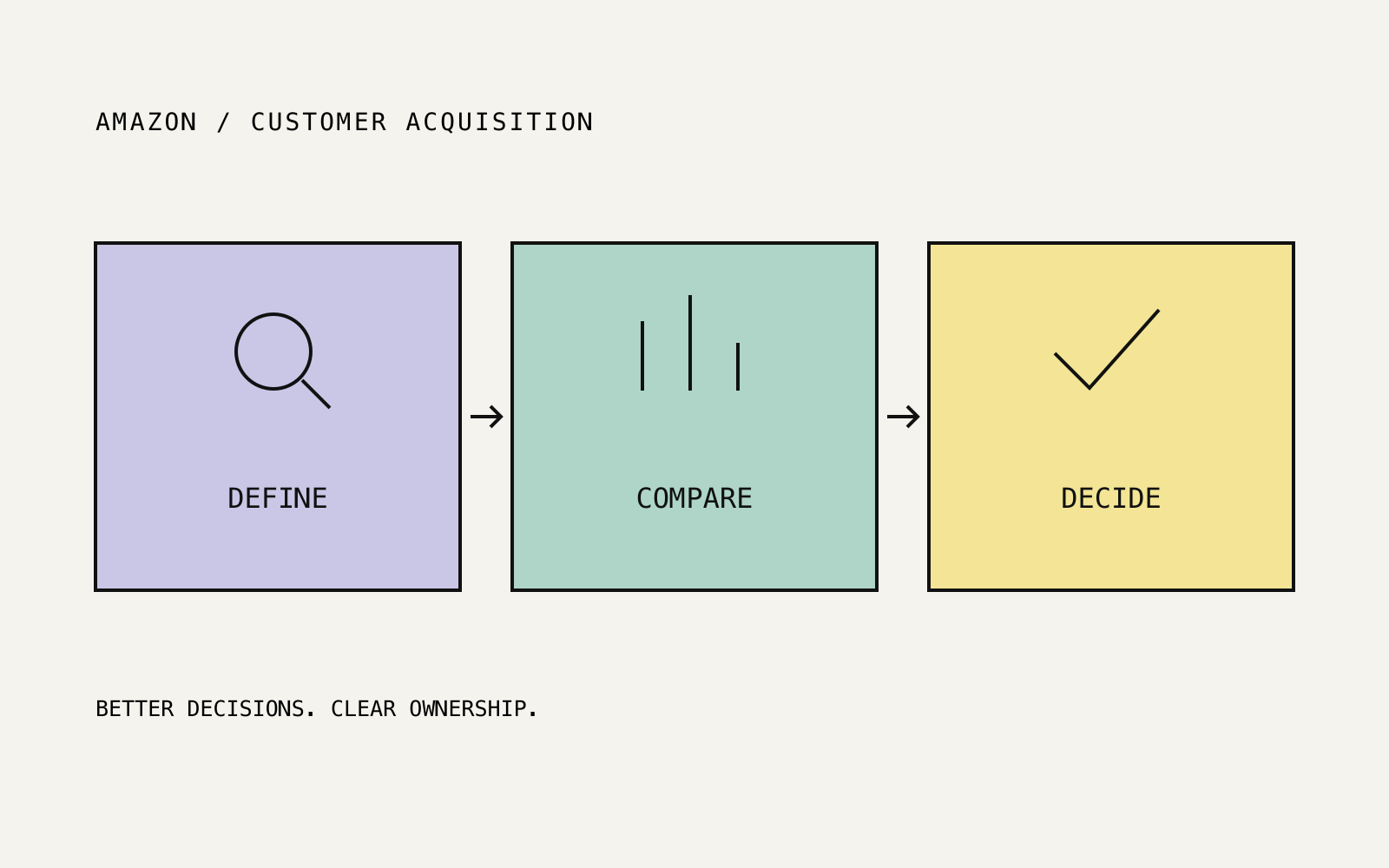
- Identify the product and audience behind the acquisition result.
- Check volume, contribution, offer quality and stock together.
- Decide whether to expand acquisition, repair the offer or support the next purchase.
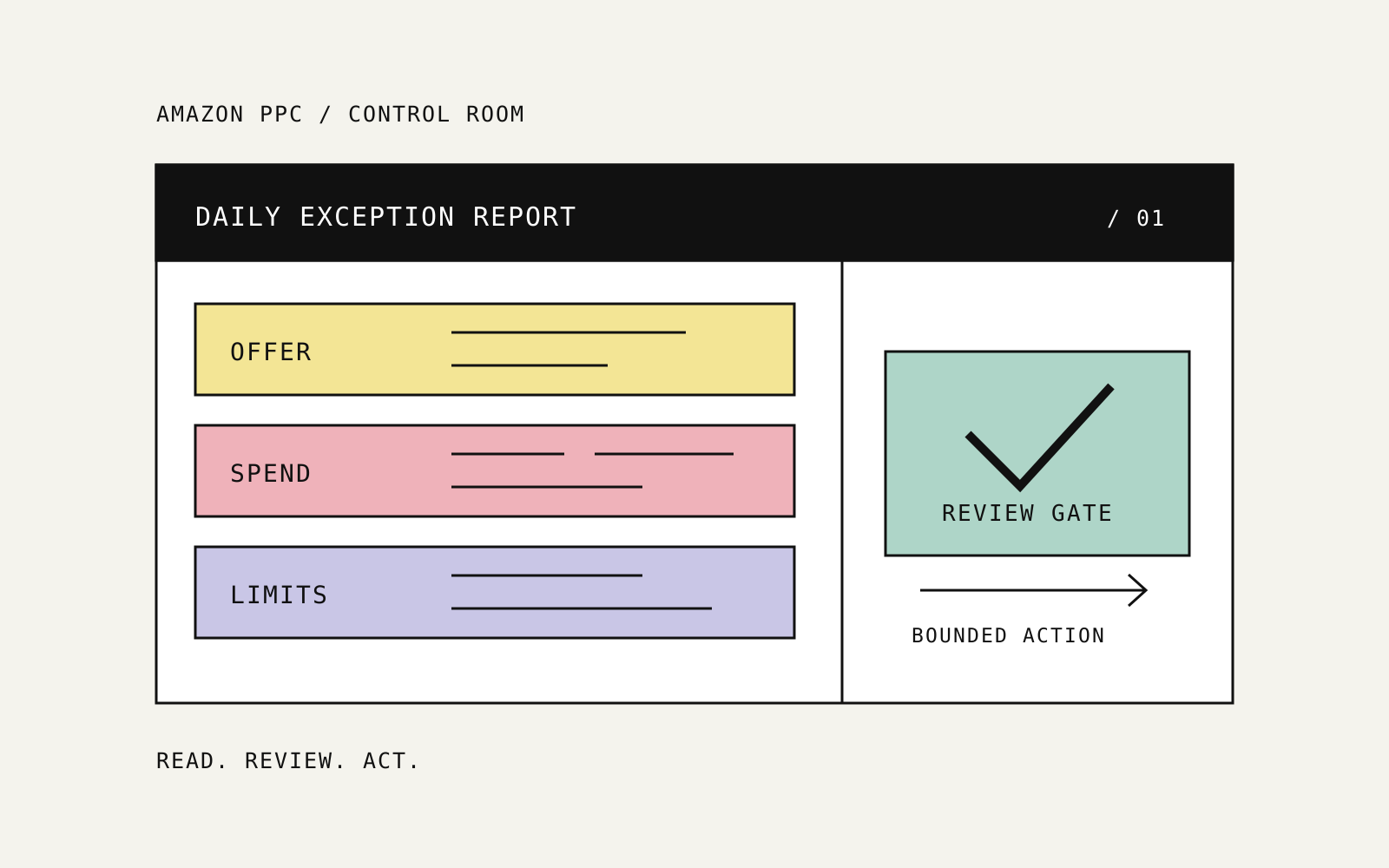
- Assign the owner, budget boundary and review window.
New-to-brand is most useful when it improves that decision. It should not become a target that every campaign must maximize regardless of its role.
Discuss Amazon growth and inventory analytics or review your advertising priorities. Bring the report names, periods and current business question so the analysis starts with compatible definitions.
Common questions
Does 97% new-to-brand mean advertising created 97% incremental sales?
No. Purchase-history classification and causal advertising impact answer different questions. Evaluating incremental impact requires an appropriate comparison or experiment.
Should I compare a sales share with a purchase share?
Not as the same measure. Order value can change the sales-based result even when the number of purchases stays the same.
Is a lower new-to-brand share always a warning?
Review acquisition volume and repeat buying first. A lower share can accompany stronger repeat sales and a healthier customer base.
Source notes
- Research as of November 18, 2026: original portfolio category screenshot dated April 1-30, 2023; the interpretation above distinguishes category hierarchy, sales share and acquisition volume.
- Amazon Ads reporting definitions explain the 12-month brand purchase-history lookback.
- Amazon Ads metric formulas distinguish new-to-brand purchase share and ROAS.
- Amazon's long-term sales overview describes additional estimated future-value measures.