Managing an Amazon PPC agency means setting the commercial objective, choosing the products that deserve investment and holding the team accountable for decisions. It is not simply asking for a lower ACoS or accepting a larger attributed-sales number each month.
My starting point is profitability. Advertising has to support the business after product costs, marketplace fees, fulfillment, discounts, returns and advertising spend. A busy account can create a lot of turnover without enough contribution to justify the activity.
The warning sign: too much dependence on paid sales
In one Amazon project, my review showed that approximately 80% of reported Amazon sales were attributed to PPC. The business was generating turnover, but advertising was absorbing too much of the economics. I changed the question from how to produce more paid sales to which product categories could support a healthier sales mix.
I identified priority categories and product groups with stronger commercial potential, focused the PPC work on the best performers, and set budget limits around the selected categories. The intention was to concentrate investment where the product and demand could support both paid activity and stronger organic performance, rather than keep financing every category at the same intensity.
Across the reviewed 365-day analysis, the PPC-attributed share moved from 80% to 64%, while total Amazon sales increased approximately 4%. Profitability improved in my assessment of the project. The published figures quantify the sales mix and total sales change; I do not substitute them for an undisclosed profit figure.
This was not a recommendation to switch advertising off. It was a different allocation of advertising around product priorities and the wider business result.
Understand the three numbers before comparing them
ACoS compares advertising spend with ad-attributed sales. TACoS compares advertising spend with total sales. Paid-sales share compares ad-attributed sales with total sales. They answer different questions.
The change from 80% to 64% is a 16-percentage-point reduction in paid-sales share, or a 20% relative reduction in that share. It is not a 16-point reduction in ACoS and does not by itself establish how much advertising spend fell.
If the sales totals and attribution definitions are consistent, a lower paid share alongside higher total sales means that non-ad-attributed sales made a larger contribution to the reported total. That is a useful commercial signal. It is not proof that every remaining order was caused by an organic-ranking improvement.
Before reviewing an agency, confirm that sales definitions, attribution windows, marketplaces and reporting periods match. Ad reports can assign sales to an interaction date rather than the retail order date, which matters when comparing short windows.
Give the agency a product-level mandate
A useful brief specifies which products deserve additional investment and why. I review contribution potential, stock, offer quality, customer demand and previous campaign performance together.
For each priority group, agree the objective, budget boundary, owner and review question. A mature product with reliable conversion needs a different decision from a launch, a weak offer or stock that must be recovered quickly.
The agency should be able to explain why it increased a budget, which evidence justified the change and what would cause it to reverse that decision. Reporting a list of optimizations is not the same as explaining their commercial purpose.
Review exceptions instead of approving endless activity
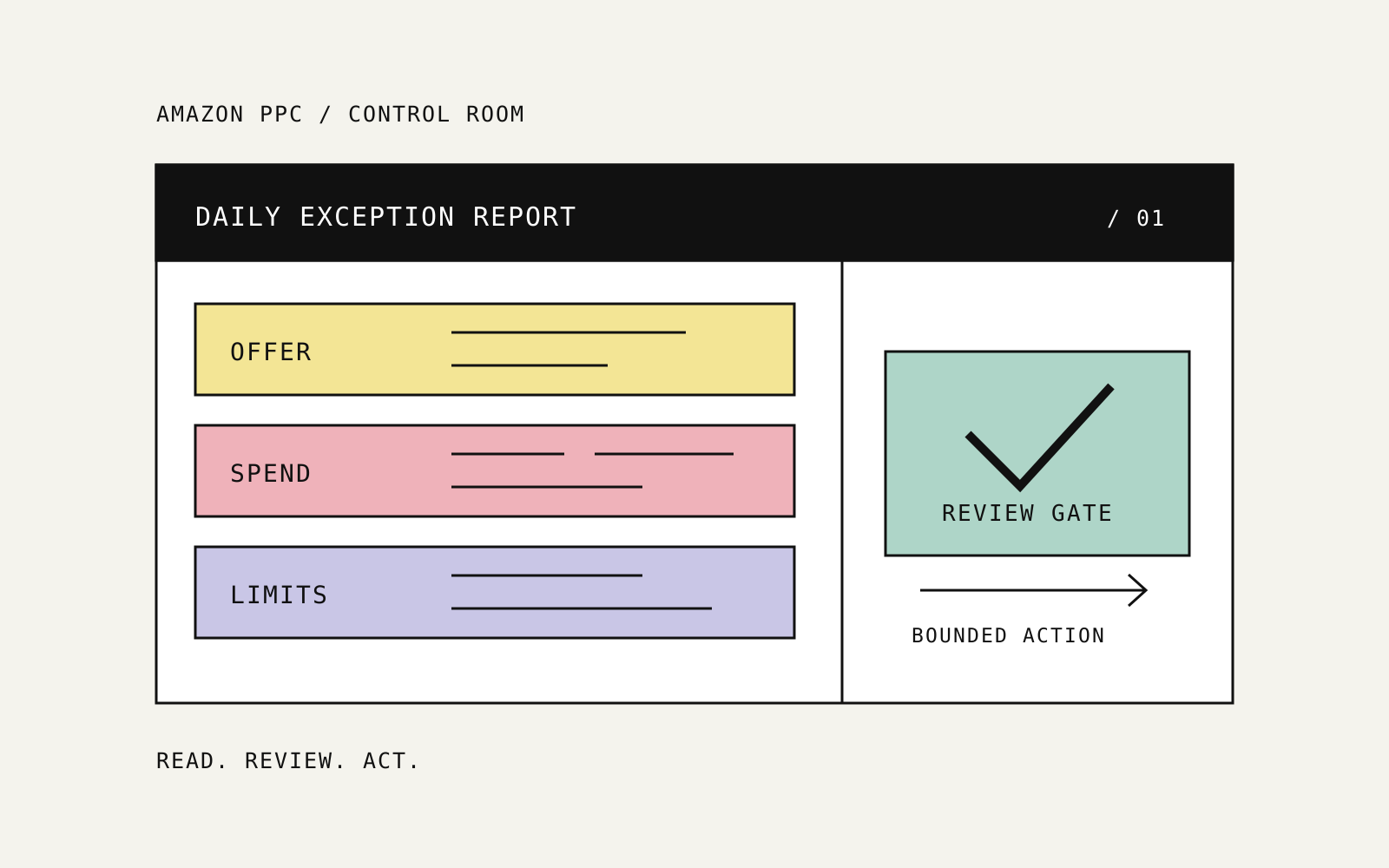
I want the review to expose the decisions that need attention: spending without a useful outcome, a budget constraint on a strong product, an offer problem, a stock risk or a category that keeps consuming spend without improving the business result.
An effective review ends with assigned actions. Which campaigns or product groups change? Who owns the offer repair? What evidence will be reviewed next? Keep a change log so the next meeting can distinguish an implemented decision from a recommendation nobody acted on.
My Amazon PPC automation framework explains how an exception report supports that process without turning every observation into an automatic bid change.
A separate agency operating snapshot
The original portfolio also contains the agency report below, with approximately $66,000 in GMV and a reported ROAS around 4.4. This is a separate reporting example, not the source of the 80%-to-64% sales-mix result above.
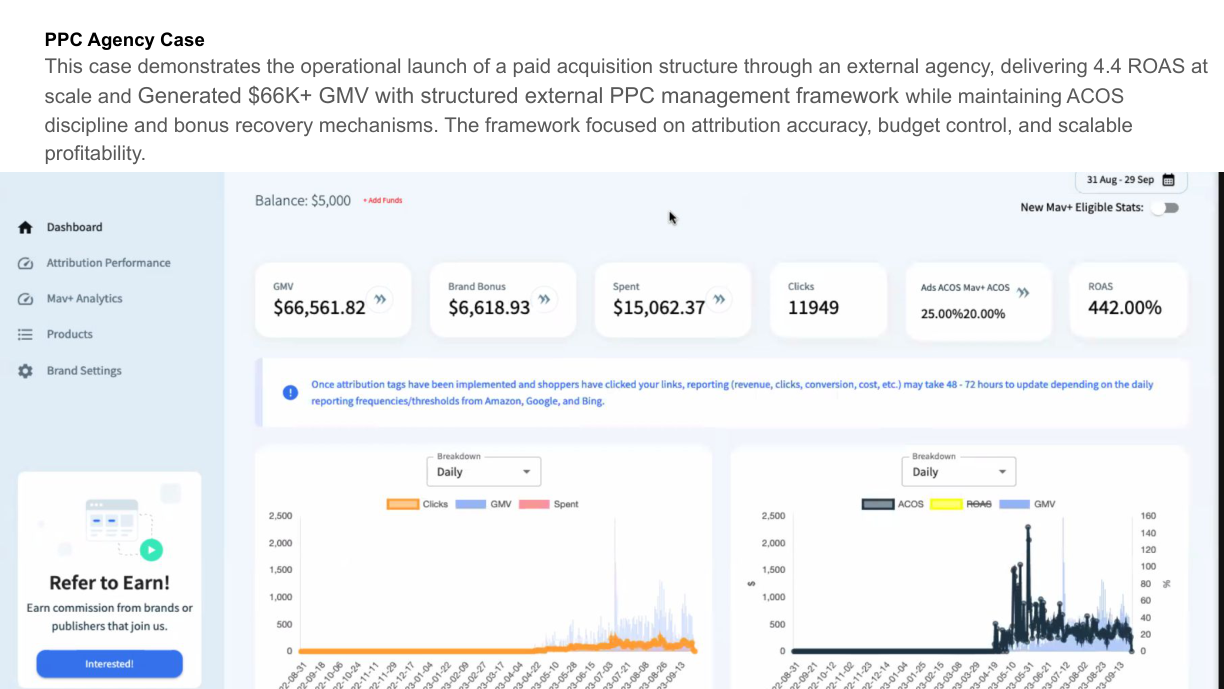
When I review a report like this, I first confirm the period, sales definition and included costs. Then I connect the figures with the budget decisions the agency actually made. A ratio becomes useful when it changes a decision, not when it merely looks attractive on a slide.
What I expect from a useful agency review
Bring total Amazon sales, ad-attributed sales, spend, product economics, stock and the current agency brief. The first deliverable should be a clear view of the commercial constraint and the decisions that follow from it.
Discuss Amazon advertising and agency oversight or start with a focused consultation. The right scope may be a diagnostic, an agreed review cycle or implementation support; it should follow the problem rather than the agency's preferred reporting template.
Common questions
Is lower ACoS always better?
No. Review the product economics and business objective. A low ACoS can coexist with missed opportunities, while a higher ratio may be acceptable for a deliberately scoped objective.
Should every brand target a 64% paid-sales share?
No. That figure is a project outcome, not a universal target. Category, maturity, margins and demand determine the appropriate decision.
Can I evaluate an agency from ROAS alone?
Use ROAS alongside total sales, product contribution, paid-sales dependence and the work implemented. Attribution ratios do not replace the wider commercial review.
Source notes
- Research as of November 18, 2026: my project account of the 365-day Amazon sales-mix analysis; the original portfolio agency screenshot is a separate example.
- Amazon Ads on ACoS defines spend relative to ad-attributed sales.
- Amazon Ads on reporting differences explains the distinction between advertising attribution and retail sales reporting.