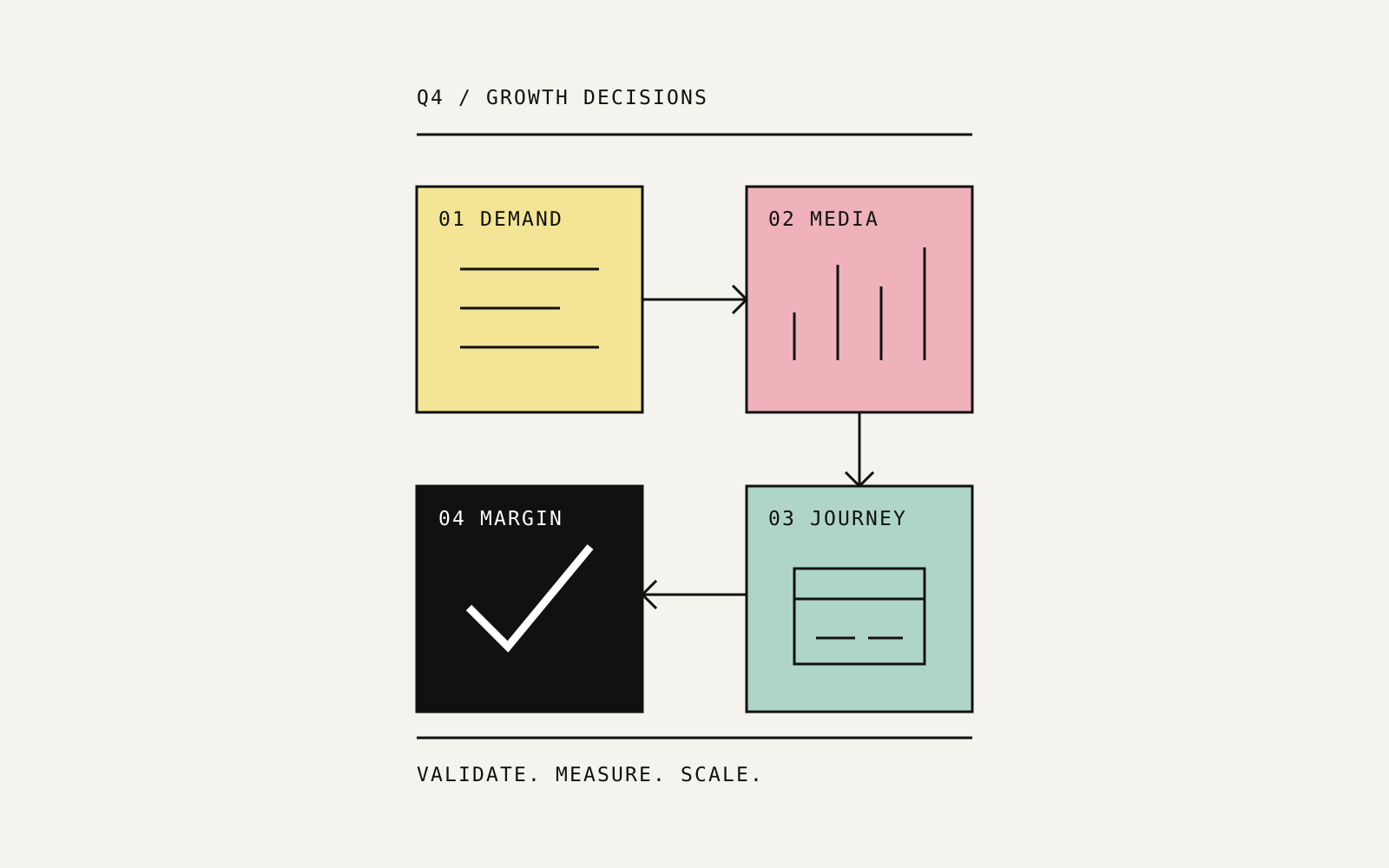
The strongest Q4 ecommerce strategy connects four things: a product people want, advertising the margin can support, a buying journey that works, and measurement that identifies the orders worth acquiring.
I reviewed the Amazon, TikTok, AI-commerce and measurement developments in the research week ending 12 October 2026. My conclusion: the useful opportunity is not another channel on the media plan. It is a better sequence of commercial decisions.
Amazon is adding launch research and merchandising tools. TikTok is bringing discovery and checkout closer together. AI makes campaign analysis and creative production faster. Each development becomes valuable when it improves a specific part of the growth system.
Here is how I translate those developments into an operating plan for brands heading into Black Friday and Cyber Monday.
Amazon launches: validate demand before buying more inventory
I start a launch review with the customer problem, not the advertising budget.
Amazon's Product Opportunity Explorer surfaces search, purchasing, review and return patterns, including areas of unmet demand. That gives product teams a stronger starting point for deciding which variation, feature or price position deserves investment.
My product brief needs five answers: what shoppers cannot currently find, what they dislike about existing options, which improvement the product delivers, where it fits on price, and whether it can make money at that price.
For a home-textile product, that could mean testing demand for a specific fit, fabric feel or care requirement before adding another color. A search-volume chart alone does not answer the buying question.
The October AM/PM launch discussion also highlighted sequencing by price point. A low-consideration item and a premium product need different levels of reassurance. I check the listing, delivery promise, product explanation and review foundation before deciding how aggressively to buy traffic.
Launch incentives belong in a second calculation. Confirm FBA New Selection eligibility and the live benefit terms, then model contribution with and without them. A rebate can improve a viable launch; it should not be the only reason the economics work.
The Amazon review-request ad beta demonstrated by AM/PM is another account-level check. If available, test its cost and effect on honest feedback against a comparison group. Keep requests neutral: the purpose is useful customer feedback, not buying a higher rating.
Amazon PPC automation: give AI a margin target, not a magic ACoS
Natural-language PPC rules make it easier to change budgets and placements. They do not make a universal threshold commercially correct.
The AM/PM automation demonstration included rules built around a fixed ACoS trigger and percentage increases in budgets or placement modifiers. My first change is to replace that generic trigger with product-level economics.
Break-even ACoS = contribution before advertising divided by net sales, multiplied by 100. Keep the sales basis consistent with the advertising report and the cost model.
Here is a simple worked example:
| Order economics | Amount |
|---|---|
| Net sales per order | $40 |
| Product, marketplace, fulfillment and expected return costs | $28 |
| Contribution before advertising | $12 |
| Break-even ACoS | 30% |
| Advertising cost at 40% ACoS | $16 |
| Contribution after advertising at 40% ACoS | -$4 |
An automation that scales this product whenever ACoS is below 40% can accelerate a loss. At 25% ACoS, the same example leaves $2 after advertising. The right operating target also depends on the product's role, repeat purchasing and the objective of the campaign.
Before write-enabled automation, I back-test proposed changes against a defined historical window, check the underlying exports and set spend limits, inventory stops and rollback rules. Start with recommendations or a small controlled scope, then expand after reviewing the decisions it actually makes.
For inherited accounts, I audit search-term spend without orders, outlier bids, naming, negatives, placement settings and product economics. A blended account ACoS can hide the exact variation or search term consuming the budget. My ACoS and TACoS framework explains how I connect those ratios to the scaling decision.
Match Amazon traffic to the shopper's next decision
A Brand Store and a product detail page solve different problems.
The October launch discussion described cohort-oriented Store experiences: introductory information for new shoppers, bundles or new arrivals for returning customers, and packs or business pricing for business buyers.
My routing principle is simple: send precise product intent to the relevant product; send comparison and discovery intent to an experience that helps the shopper choose.
I test Sponsored Brands destinations by intent group rather than moving every campaign to the Store. Compare the destination's purchase conversion, order mix and contribution. A stronger-looking page earns its place by improving the decision, not by generating more page views.
TikTok commerce: prove the product angle before expanding reach
TikTok is developing Buy Direct and Shopping Assistant: in-app buying from brands and conversational help with product questions. Availability is a check for the relevant store and market, not an assumption in the forecast.
The commercial implication is straightforward: product facts, inventory and order tracking need to remain consistent when discovery and checkout happen on a new surface.
The first question is still product fit. Marketplace Pulse's October report, based on more than 150,000 US sellers and 4.5 million products, finds that over two-thirds of top-product revenue comes from products applied to, consumed by or worn on the body. The median top product is around $40.
My takeaway: Amazon demand does not establish a TikTok-native selling angle. Build a visual demonstration that makes the product's value obvious in seconds, then test whether that attention produces worthwhile orders.
For TikTok Ad Network expansion, evaluate purchases, refunds and customer quality by placement. More app inventory creates more places to spend; it does not establish better customers.
Of the automation ideas in the research, I prioritize inventory protection first. Define stock buffers from sales velocity and replenishment lead time. Promote proven videos only after paid-usage rights are recorded, and assess weak videos using enough conversion data rather than an arbitrary early click threshold.
AI creative should accelerate testing without changing the product
Cheap AI video is useful when it lowers the cost of testing a message. It becomes expensive when it changes the product customers think they are buying.
My preferred workflow starts with real product footage or photography. Use AI to explore hooks, edit pacing, create backgrounds or develop storyboards. Check fabric texture, fit, color, packaging and product claims before release.
A synthetic presenter is a separate creative decision, with explicit approval and appropriate disclosure, not a default substitute for a real testimonial or customer demonstration.
For the test, hold the offer and audience approach steady. Compare one creative question, then judge the outcome through purchases and contribution as well as viewing and clicking. I use the same controlled-testing approach across creative and acquisition.
Google Ads promotions need an owner before BFCM
Google's automated promotions documentation describes website-sourced offers for eligible Search and Performance Max campaigns with location assets and no running manual promotions. This is an eligibility-specific setting, not a change to every ecommerce campaign.
The immediate task is to inspect what can appear: the offer, code, exclusions, destination and current website copy. Manual promotion assets are the better choice when the exact message and dates need direct control.
I also keep creative experiments separate from offer operations. A useful experiment needs a stable comparison; a holiday asset group that constantly changes discounts is a poor place to isolate one creative effect.
Give one person responsibility for the agreement between the website, promotional assets and checkout. That is how a campaign avoids advertising a deal the customer cannot redeem.
Measure ChatGPT referrals as a commercial source
AI visibility becomes useful when it brings relevant people to pages that help them act.
Ann Smarty's ChatGPT measurement walkthrough provides a practical starting point: inspect session source/medium in GA4, filter for ChatGPT-related sources and review their landing pages.
I build the readout around five questions: which pages receive those visits, what intent the pages serve, whether visitors engage, whether they complete the intended action, and whether the resulting leads or customers are valuable.
Use explicit source domains and known campaign tags. Missing referrer information can hide part of the traffic, but an increase in Direct or Unassigned is not proof of ChatGPT growth. Asking an AI tool which prompts might cite a page generates research ideas, not a log of real visitor prompts.
For content, I prioritize clear answers, useful examples, consistent product facts and visible authorship. These help readers evaluate expertise and make the page easier to interpret. The destination still needs a clear next step. My marketing and sales analytics service connects source reporting with that commercial outcome.
Audit the mobile journey inside the apps sending the traffic
A desktop review cannot tell you what a new shopper experiences after tapping an Instagram or TikTok link.
The mobile-friction checklist from Practical Ecommerce reinforces a QA habit I consider essential: start cold, on a real phone, inside the actual app browser.
My checks cover consent choices, competing pop-ups, readable product information, image zoom, size guidance, variant selection, payment options and the route back from checkout. Measure how much of the screen remains after sticky navigation and purchase controls appear.
For Shopify stores, test cross-device cart behavior and the combined reminder experience from Shop, email and SMS. A recovered-cart dashboard can look healthy while the customer receives several overlapping messages.
Fix the obstruction before buying more traffic. Better acquisition does not compensate for a buying journey that gets in the customer's way.
BFCM offers should earn the second purchase
Discount depth is only the first part of an offer decision. I also want to know which customers return and what their next order contributes.
The Smile.io research discussed in DTC's October newsletters reported a 60% higher 90-day repeat rate among first-time BFCM buyers who joined a loyalty program. That comparison is a useful reason to investigate retention, not evidence that enrollment alone creates the lift.
My cohort review separates first-order discount, product mix, acquisition source and loyalty enrollment. Compare contribution from the first order and the following 90 days, including returns and the cost of subsequent incentives.
Test the next reason to buy: a relevant complementary product, replenishment, a useful bundle or a membership benefit. Another discount should be a deliberate choice, not the only available follow-up.
For offer planning, use the same contribution and inventory gates before committing to peak demand.
New channels belong behind a clear decision gate
The research also covered Meta shopping-agent protocols, Walmart DSP access to Spotify inventory and the USPS-Amazon same-day delivery pilot. These are different opportunities, not one reason to expand every budget.
For merchant-facing shopping agents, prepare accurate product information and check access controls. Keep product discovery, referred sessions and orders as separate measurements.
For retail-media audio, first establish DSP access, budget suitability and a credible comparison for additional sales. Closed-loop attribution is useful; it still needs a business question and a test design.
For a delivery pilot, change the customer promise only when the service actually applies to that product and location. An industry announcement is a monitoring signal, not a fulfillment commitment.
My Q4 execution order
I prioritize work that protects existing demand before opening a new spending surface.
| Priority | Work | Decision it supports |
|---|---|---|
| 1 | Recheck contribution, stock coverage and exceptional PPC spend | Which products can support more demand? |
| 2 | Complete a cold mobile and checkout audit | Can paid visitors buy without avoidable friction? |
| 3 | Review live promotions, product facts and campaign destinations | Does the offer match what the customer sees? |
| 4 | Establish source-to-order or source-to-lead reporting | Which traffic produces commercially useful outcomes? |
| 5 | Run one bounded automation, creative or channel test | What deserves expansion after the evidence arrives? |
This is where I add value as a growth consultant: turning platform updates into a sequence the team can execute, measure and improve. The result I look for is profitable demand and a repeatable decision process, not a longer list of tools.
Discuss your Q4 growth priorities, or explore my Amazon advertising consulting and growth strategy work.
Questions I get about Q4 ecommerce growth
What ACoS target should an Amazon PPC automation use?
Start with product-level contribution before advertising, then set the operating target around the campaign objective and required profit. One fixed percentage across a catalog ignores differences in price, fees, fulfillment, returns and product role.
Does strong Amazon performance mean a product will work on TikTok Shop?
No. Amazon captures substantial product-search intent; TikTok requires a compelling content-led discovery angle. Validate the demonstration, creator economics, stock availability and purchase quality before scaling.
How do I know whether AI visibility is bringing business?
Connect identifiable AI referrals to landing pages and completed orders or qualified enquiries. Track visibility separately. Missing referrers limit attribution, and Direct traffic cannot simply be reassigned to AI.
Source notes
- Research - 12 October 2026: Amazon launch and advertising tools, TikTok commerce, AI-assisted creative, Q4 measurement and buying journeys.
- Amazon launch research: Product Opportunity Explorer and AM/PM Podcast #562, including product validation, launch sequencing, incentives, Store destinations and account audits.
- Automation and emerging channels: AM/PM Weekly Buzz #561, covering PPC rules, TikTok advertising, shopping-agent access and retail-media audio.
- Review-request demonstration: AM/PM: Amazon Ads For Getting Reviews, 7 October 2026.
- TikTok product announcements: TikTok's advertiser update, 5 October 2026.
- TikTok category research: Marketplace Pulse: What 4.5 Million Products Say About TikTok Shop, 9 October 2026.
- Promotion settings: Google Ads: About Automated promotions.
- AI referral measurement: Ann Smarty: How to Track ChatGPT Traffic in GA4.
- Mobile conversion: Lihi Lothan: Desktop Habits Hide Mobile Friction, 8 October 2026.
- Cart continuity and retention: DTC Newsletter 1175, including the Smile.io BFCM loyalty comparison and Shopify cart updates.
- Launch economics example: the $40 order and associated costs are a worked calculation illustrating the break-even ACoS formula.