5.2x organic traffic from a legal-content refresh
I led a focused SEO content-refresh project that grew an existing article's organic landing sessions from 9 to 47 across comparable 28-day windows. Google visibility improved and engagement held, before the planned paid placements.
- Client
- European legal-services company / international audience
- Period
- Content update 30 September 2026 / reporting through 4 November 2026
- Contribution
- Experiment strategy, scope refinement, SEO coordination and performance analysis
Content-refresh result
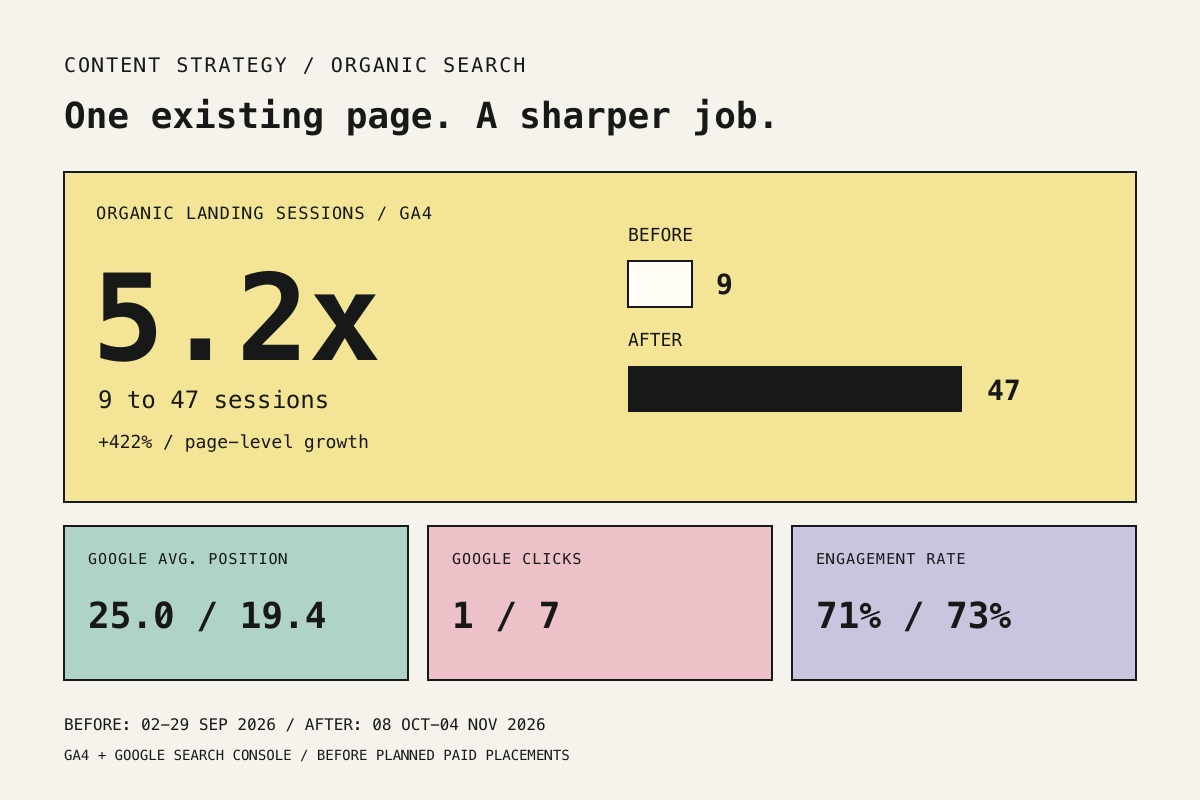
Organic landing sessions increased 5.2x, from 9 to 47. Google average position improved from 25.0 to 19.4, clicks rose from 1 to 7 and engagement rate increased from 71% to 73%. The largest traffic gain came from Bing-related sources. The completed phase delivered stronger visibility and readership; form inquiries remained the next commercial objective.
The result: 5.2x more organic landing sessions
I led a focused content-refresh experiment for a European legal-services business. The objective was to make an existing informational article more useful, easier to discover and better aligned with its specific search intent, without creating another page competing with the main commercial offer.
After the update, organic landing sessions increased from 9 to 47 across equal 28-day windows: 5.2x the original level, or a 422% increase. Google average position improved from 25.0 to 19.4, and Google clicks increased from 1 to 7.
The stronger traffic did not come at the expense of engagement. The reported engagement rate rose from 71% to 73%, while average session duration increased from 80 to 93 seconds.
The content-refresh phase delivered a measurable improvement in discovery and readership before the planned paid placements. No form inquiries had been recorded from the page at the reporting checkpoint. That made the next commercial priority clear: connect the improved readership to a stronger consultation journey.
The page-level result
Equal 28-day windows show the traffic, Google visibility and engagement changes together.
The challenge: improve discovery without creating competing pages
The original brief proposed two AI-visibility experiments: a LinkedIn-led eligibility resource and a press-release-led document checklist. Each would have had its own landing page, campaign tracking and reporting.
The review exposed a more important structural issue. The homepage already covered the core commercial questions about eligibility, process and required documents. Publishing new general-purpose pages on the same topics would risk rebuilding an overlap the website did not need.
I refined the approach around a simpler principle: give each page a distinct job before adding another URL.
The revised brief kept the commercial eligibility information on the homepage and used an existing article for a separate informational intent: finding and verifying ancestral records. That created a useful distinction between understanding a service and researching the documents behind a personal situation.
The strategic decision: improve the asset already in place
The existing guide offered a stronger starting point than a fresh, overlapping landing page. Its archival-research topic could support practical educational content without competing directly with the homepage's commercial role.
The revised plan separated the destinations and measurement paths for future social and PR activity. The phase reported here then focused on the article update itself: content, republication, reindexing and the subsequent performance review.
This sequencing gave the team a useful answer before committing more budget: could the improved article gain traction on its own? The subsequent reporting showed that it could.
The scope decision behind the work
The homepage and the existing article were given different search jobs, then the content-refresh phase was measured before further paid outreach.
What the team changed
The article was updated, republished and submitted for reindexing on 30 September 2026. The work converted a broad informational piece into a more practical research resource.
- A free ancestral-records search checklist gave readers a concrete way to organize the task.
- A record-type table connected each document with the information it could support, where to search and its limitations.
- Specific guidance covered birth and marriage records, emigration and naturalization documents, historical passports and church records.
- Additional guidance addressed differences in names, dates and place names across records.
- Official archive sources, authorship, review information and accurate publication/update dates strengthened the content's context.
- The article distinguished researching family history from establishing legal eligibility, keeping the informational and service purposes clear.
My contribution connected the experiment brief, page-intent decisions, execution coordination and interpretation of the results. The SEO work followed the revised scope rather than expanding the site with more near-duplicate pages.
How I structured the measurement
The review compared two 28-day windows:
| Window | Dates |
|---|---|
| Before | 2-29 September 2026 |
| After | 8 October-4 November 2026 |
The post-update window started eight days after republication, allowing an initial period for recrawling and reindexing. Baseline GA4 and Search Console figures were recorded, form-event tracking was checked, an AI-assistant channel was configured, and UTM links were prepared for later placements.
I kept three questions separate: did the page become easier to find, did more readers arrive, and did those readers submit an inquiry? That separation prevented a traffic improvement from being confused with a lead-generation result.
Google visibility improved while wider site metrics weakened
The page's Search Console results moved in the right direction:
| Google Search Console | Before | After |
|---|---|---|
| Clicks | 1 | 7 |
| Impressions | 437 | 547 |
| Click-through rate | 0.23% | 1.28% |
| Average position | 25.0 | 19.4 |
That is a 5.6-position improvement in average position and approximately 25% more impressions. The page improved during a period when total site Google clicks fell from 691 to 585 and site impressions declined from 51,288 to 44,873.
I used that wider movement as context, rather than treating every page gain as part of a sitewide uplift. The blog tracker provided an additional reference point, but its snapshot dates differed, so it was not treated as a matched control experiment.
The query review also showed where the next work belonged. Larger research terms still had room to improve, while more specific long-tail searches were beginning to appear at stronger positions. That supported further refinement of the article and its internal links, rather than abandoning the topic after the first review.
Most of the additional readership came from Bing-related sources
GA4 showed a broader increase than Google clicks alone would suggest:
| Page and landing-page measures | Before | After |
|---|---|---|
| Page views | 15 | 61 |
| All landing sessions | 11 | 52 |
| Organic landing sessions | 9 | 47 |
| Engagement rate | 71% | 73% |
| Average session duration | 80 seconds | 93 seconds |
The source breakdown was the decisive detail. Approximately 39 of the 47 organic sessions came from the source group reported as Bing, DuckDuckGo, Yahoo and Ecosia, compared with 6 of 9 before the update. Google search visibility improved as well, but Google was not the main source of the additional sessions.
That distinction made the analysis more useful. Search Console measures Google's search activity; GA4 also records visits from other search sources. Looking at both explained the difference between seven Google clicks and 47 organic landing sessions without forcing the numbers into the wrong story.
The budget decision: establish the content result before paid outreach
The planned paid placements for this page had not run during the review period. I kept their proposed impact separate from the completed content-refresh result.
That mattered because the destination was an informational article, not the core service page. Before increasing spend, the business needed evidence that the resource was useful enough to attract and retain readers.
The November plan allocated five of ten proposed placements to this article, with varied anchors and prepared tracking. This remained a next-phase plan, not something included in the measured result. The completed refresh had already established a positive traffic and engagement baseline for deciding what to fund next.
AI visibility and inquiries: distinct next-stage objectives
The project began with an AI-discovery ambition, but the completed reporting supports a clear organic-search content case, not a claim of proven AI citations or AI-generated leads. Page-specific AI visibility had not been established at the checkpoint.
Google also includes its AI search-feature activity within Search Console's overall Web reporting. A rise in general Google impressions is therefore not a separate count of AI mentions.
The same discipline applied to conversion. The report recorded one key event for the landing-page cohort, but did not establish a form inquiry from the article. I kept it out of the lead count. The next implementation priority was a clearer route to a consultation or relevant form, with clicks and successful submissions measured separately.
What this project demonstrates
This project delivered a fivefold increase in organic landing sessions from a focused update to one existing article, alongside stronger Google visibility and maintained engagement.
The valuable work was not adding more pages or rushing into more distribution. It was separating search intent, improving a useful asset, coordinating the update and reading the channel-level results before expanding the budget.
The content-refresh phase was completed and measured. The next growth phase had a concrete starting point: 47 organic sessions, stronger visibility and an identified conversion opportunity.
Explore SEO strategy and organic growth, marketing and sales analytics or discuss your content-growth challenge.
Page-level GA4 and Google Search Console comparison: 2-29 September versus 8 October-4 November 2026, 28 days each. Content updated on 30 September; results reviewed on 5 November. Charts visualize the reported figures.