A cross-team decision workflow for products, stock and returns
I translated product, inventory and commercial discussions into shared decision criteria, assigned tasks and accountable follow-through across teams.
- Client
- Amazon bedding company / cross-functional operations
- Period
- Documented working sessions December 2024 - March 2026
- Contribution
- Meeting facilitation, process alignment, recaps and task coordination
Delivered result
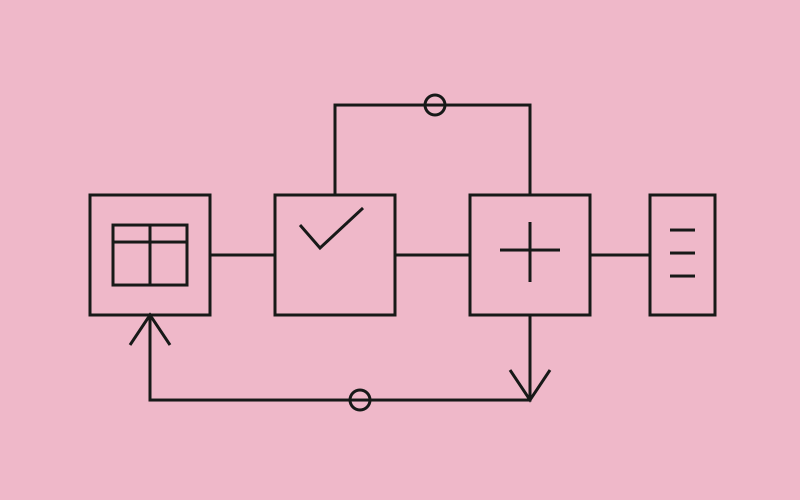
A documented cross-functional workflow connecting product evaluation, inventory, returns and operational follow-up. Working sessions became recaps, validation tasks and assigned owners, keeping decisions connected to the people responsible for execution.
The result
I moved cross-functional product discussions towards concrete execution: define the question, agree on the evidence, record the decision criteria and assign the next action. The completed work is visible in working-session recaps and follow-up tasks across product lifecycle, stock, returns and warehouse planning.
The outcome was stronger operating discipline: analytical questions no longer needed to remain disconnected from owners and next steps.
The challenge
When a product underperforms, the decision is rarely owned by marketing alone. Sales, stock availability, margin assumptions, product development and supply-chain constraints all affect whether to improve, replenish, discontinue or liquidate it.
The operating challenge was to connect those inputs before decisions became a series of disconnected discussions.
My contribution
The working-session archive documents my facilitation of a product-lifecycle and evaluation discussion, preparation of recaps and follow-ups, and conversion of cross-functional planning into assigned tasks.
In the lifecycle session, the team worked through decision triggers, measurement periods and how an intake form would fit into the existing workflow. Later sessions show coordination around stock, returns, liquidation, packaging validation and warehouse assortment planning.
This was collaborative work. Product, finance, sales and warehouse specialists owned their functional assumptions and execution.
Building a decision workflow
The useful structure was straightforward:
- Define the product question and the relevant review period.
- Identify the data needed from sales, inventory and finance.
- Agree on the criteria and record unresolved assumptions.
- Assign validation and implementation to named internal owners.
- Revisit the decision when the required evidence is available.
The workflow made product decisions specific to their commercial context, with clear criteria and accountable follow-up.
Inventory context
The report descriptions distinguish physical stock from sellable availability. Production, transit, receiving, reserved, defective and fulfillment-ready stock cannot be treated as interchangeable.
The operating view values inventory at COGS and supports internal stock diagnostics. Demand, lost sales and replenishment each have defined metrics and supporting reports.
Reviewing listing changes with the right context
The SKU changelog specification connects dated price, image, content and promotion changes to units, sales, sessions and conversion. Its conversion metric is units sold divided by sessions.
The workflow separates two questions: did visibility change, and did the available traffic produce more units? Reviews use comparable periods and account for seasonality, stock availability and promotions. The changelog connects listing activity with the performance signals the team needs to investigate.
Connecting returns to product decisions
The sales-and-returns specification distinguishes money, units and orders, and allows returns to be reviewed either by refund date or by the original order date. The first is useful for current operational pressure; the second helps evaluate the sales cohort that later generated returns.
This matters when deciding whether a product problem is new or simply became visible later. An increase in returned units is not the same as an increase in monetary return rate. Product-level review should preserve the measurement mode and cohort before assigning a follow-up.
These report definitions supplied the operating context for cross-team discussions, helping turn performance questions into focused validation tasks.
Documented outcome
I delivered recaps, coordinated follow-up and translated recurring working sessions into explicit validation tasks and ownership. That connected product decisions to execution across marketing, sales, finance and operations, giving the team a repeatable way to move from discussion to action.
Source notes
December 2024 lifecycle and evaluation session, 2025 operational review notes, November returns/liquidation kick-off and March 2026 warehouse planning discussion. Supporting specifications cover inventory, the SKU changelog, and sales and returns.
Related expertise
Marketing and sales operations, Product line growth and Amazon inventory analytics.
Working sessions and follow-up records from December 2024 - March 2026 document the product-review workflow, decision criteria and assigned actions.